Monday, February 2, 2015

Mars Needs Women, Venus Needs Men


Apparently, in the 1960's, several planets in our solar system suffered critical shortages of the opposite sex and looked to the earth to replace their gender-deficient populations. Two films, one made in the US and the other produced in Mexico, relate this type of story with minimal resources and maximum cheese. For an old-school sci-fi fan like myself, who likes nothing better than astronauts who wield .38 police specials instead of laser blasters, wear leather bomber jackets instead of bulky space suits, and pronounce the word for mechanical man as "ro-butt" instead of the correct way that Billy Mumy enunciates it in Lost in Space, movies such as these are wheelhouse material.


La nave de los monstruos (The Ship of Monsters) Directed by Rogelio A. González

Due to an "atomic scourge" that has wiped out all the men on their planet, two fashionable Venusian space ladies are dispatched to bring back males wherever they can find them from around the galaxy. After collecting several species from various worlds and freezing them Han Solo-style in their cargo bay, the aforementioned astro-babes, Gamma (Ana Bertha Lepe) and Beta (Lorena Velázquez), along with captured robot, Torr, make an emergency landing on what turns out to be earth.


Meanwhile in Chihuahua, a happy-go-lucky, singing caballero by the name of Lauriano ( Eulalio González aka 'Piporro'), who is on his way home from the local tavern where he has just spent the evening hanging out with his buddies and spinning tall tales, sees what he believes to be a shooting star. He wishes on the star, which is actually a spaceship, for a beautiful woman to love but is surprised when his wish is doubly granted in the form of Gamma and Beta. Of course, complications ensue because "love is meant for two, but for three, it's just French" and a rivalry develops between the Venusian ladies culminating in one of the most outrageous plot developments ever. Like Lauriano's impossible to believe tall tales, this big twist will make no sense whatsoever, except to fans of Mexican cinema, in which case, it will make perfect sense.


The Ship of Monsters is a comedy/romance/sci-fi/adventure romp that succeeds in large part due to the sweet, heartfelt and witty script by José María Fernández Unsáin and Alfredo Varela who understand the film is suppose to be breezy and entertaining but not too dumb. The clever dialogue and efficient writing helps maintain a smooth, quick pace and is quippy from start to finish with an enjoyable story featuring likable characters. The lead, Eulalio González, gets all the best lines as when he discovers the girls aren't from earth and exclaims, "Venusians!? I thought you were just white girls or something." When telling his amigos of the cyclops alien monster he's recently battled, he describes it as "...a monster with just one eye, but nevertheless watchful." And when explaining to Gamma why he won't be able to enlist his skeptical friends to fight the monsters, he states, "If they don't believe my well-crafted lies, they'll believe my ugly truths even less." At times, there's a surprising, enjoyably risque quality to the script especially considering the time of the production was 1960 and the place was socially conservative Mexico. In an early scene when Lauriano tries to suss out if the girls are available, he asks, "Single? Married? I hope you don't swing the other way!" There's also a running gag involving Lauriano's younger, underaged brother, Chuy (Heberto Dávila Jr.), who either gets sent out of the room or has his ears covered by the robot when there is some adult situations or conversation about to transpire.


The trope of aliens being ignorant of love and having to learn from the less intelligent, less evolved earthlings is a common one in 50's sci-fi, but it works very well in The Ship of Monsters because it's not taken deadly serious, but at the same time, the humor doesn't feel strained or clunky either. There's definitely a strong undercurrent of innocent sexuality that runs through the film and manifests itself in the ladies' sexy costumes and the verbal interplay with Lauriano's character. Also, it seems like every character in the film is trying to get their shwerve on including the monsters and the robot.


The enjoyably distinctive monsters include a giant cyclops, Uk, who is very Groot-like; the dwarfish, brain-exposed, prince of Mars, Tagual; the skeletal, Zok, who has evolved beyond the need for physical form (but apparently still requires his bones); and lastly, a big furry, orthodontically-challenged insect thing-y with poisonous pincers. All of them have personalities that are a bit more developed and certainly more slyly humorous than the average low budget, sci-fi/horror creature. The final battle involves all of them, except Zok unfortunately, but still provides a satisfying climax.


That the film is a big wedge of low budget cheese, there is little doubt. Gamma brandishes what is clearly a child's toy gun complete with a visibly open battery cover on the butt end of it. Beta's all-purpose scanner and freeze device is a spray-painted and taped-up cardboard box. The robot is similarly constructed with less than space age technology. But all these shortcomings actually add to the charm and sweetness of the adventure making it into something both children and adults can enjoy. 


***

Mars Needs Women (1968) directed by Larry Buchanan 


People who are under the mistaken belief that Ed Wood is the worst filmmaker of all time have obviously never seen a Larry Buchanan joint. The self-proclaimed "schlockmeister" didn't make just bad films, he made painfully dull, unwatchable films. He is best known for re-making AIP movies for television including two of my favorite Corman pictures, Day the World Ended (remade as In the Year 2889) and It Conquered the World (remade as Zontar, the Thing from Venus). Buchanan drained everything that made the Corman pics the slightest bit interesting, atmospheric or entertaining on any level and added color photography resulting in two incredibly boring, non-black and white films. In Corman's Day the World Ended, there's a shocking scene involving the Mike Connors' character tossing someone off a cliff. In Buchanan's version, the same character lamely drowns someone in a backyard swimming pool. Corman wasn't the greatest director but at least he'd toss the audience something to sustain interest on occasion. Buchanan sadly lacks that talent completely.
Mars Needs Women is, without a doubt, one of the most evocative titles anyone has ever come up with. Unfortunately, the film fails to deliver on it in any way. It starts promising enough with various women disappearing while doing normal activities like playing tennis, dining or, my favorite, showering, but quickly loses momentum as it moves to the Decoding Center of a military base which looks suspiciously like an airport restaurant. The cheap, generic, open-to-the-public appearance of the Decoding Center control room in the NASA building is only a portent of crappy set locations to come.


Later on in the film, there will be ugly gas stations, tacky motel rooms and bland high school football bleachers to provide the pulse pounding atmosphere and stunning visuals. When the commanding officer arrives at the Howard Johnsons - er, I mean, Decoding Center - he is given the decoded message "Mars Needs Women". After a ridiculous, heated exchange with an on-site news reporter (?) and a meeting with the Secretary of something or other, the C/O comes to the control room where another message has been received advising of the imminent arrival of the aliens. The leader of the martian expedition, played by Disney kid, Tommy Kirk, appears unceremoniously, and apparently to no one's great surprise, in the decoding room. He explains that due to some DNA problem, there is only one female per one hundred males on Mars and they need to abscond with some earth females. Kirk then disappears and the C/O advises the on-site reporter to relate the story to the world just like any competent military leader would. What follows is a lot of stock footage and needless dialogue that slams the breaks on any momentum gathered by the movie so far. The subsequent arrival of the martians, who look like a 60's pop band consisting of five Young Republican surfers complete with wet suits and headphones, doesn't do anything to help entertainment matters.


Despite the somewhat promising title and set-up, the film devolves pretty quickly. There is way too much faux sci-fi speak dialogue, also courtesy of Larry Buchanan, none of which is funny or interesting in the least. The closest thing to intentional humor concerns one of the martians becoming aggravated by men's ties when they decide to dress incognito. But it's amazing how rarely Buchanan even attempts humor at all. The actors, who are all pretty terrible to begin with, clearly don't have the skills to improv and the script is devoid of any situational comedy. What remains is a lot of people standing around uncomfortably waiting to deliver nonsensical lines consisting mostly of bad pseudo-science jargon. Yvonne Craig of Batgirl fame could have provided a spark but she's criminally underused and doesn't really enter the picture significantly until the last act. Tommy Kirk resembles a P.O.W. reading lines about his captors fair treatment of him for most of the film. None of the supporting martians bring anything to the table either and a promising scene at a strip joint completely fizzles. The ladies that are targeted for abduction hardly get to speak at all. In short, there's no character development and little story to sustain interest.

Mars Needs Women ultimately fails because it's an obvious and cynical cash-in attempt on an intriguing title. It feels very thrown together with minimal thought and effort put in resulting in a lifeless, joyless, choppy yet meandering slog through a barely there story. The Ship of Monsters succeeds, despite a budget commiserate with Buchanan's because it has heart, humor and a fun-loving quality behind the filmmaking.

Final scores:
The Ship of Monsters 6.75
Mars Needs Women 2.25


Tuesday, December 30, 2014

Top 30 film discoveries for 2014

My weirdly eclectic tastes are on full display in this year's top 30 film discoveries. The fact that seven different decades are represented with westerns, noir, horror and science fiction films making strong showings shouldn't surprise. Nor should the fact that directors like Sam Fuller, Fritz Lang, Anthony Mann, Robert Wise and William Witney are favored. What is unusual is that four of my top five first time watches are silent films. Clearly, I should visit this genre much more often.

30. Missile to the Moon (1958)


I'm a sucker for 50's sci-fi especially when it involves traveling to a planet inhabited by love-starved ladies. This movie is awesomely ridiculous in its premise concerning a research scientist who forces two juvenile delinquent-type prison escapees to help him pilot a homemade rocket ship to the moon. Of course, it turns out the moon is populated by rock monsters, big spiders, and most importantly, beauty contest winners. Like all great cheesy sci-fi, its earnestness in the face of the ludicrous story and terrible production values (highlighted by wrinkled matte backdrops) make it that much more enjoyable.
29. Colorado Sundown (1952)

One of four William Witney movies on the list, I discovered this Rex Allen singing cowboy picture when looking for early Slim Pickens movies. Slim puts on a real tour-de-force comedy performance but I was equally pleased by Allen's singing skills and the overall enjoyable, feel-good quality of the piece. Also a pleasant surprise is the level of villainy displayed by the black hats who are uncharacteristically led by a female baddie. Like most, I use to shun singing cowboy movies as corny and old fashioned, but after watching Colorado Sundown, I tracked down the other 18 Rex Allen films and began digging deeper into Witney's filmography.

28. Shoot (1976)

The adult male's love affair with guns and all things paramilitary is explored in this smart, unsettling war allegory. Cliff Robertson is solid as the leader of a group of weekend warriors who happen across another, similar group while on an outing resulting in a violent confrontation. Briskly paced, tense and unpredictable, featuring some odd characters like Kate Reid's bizarre, not-so-grieving widow, the film is an engaging indictment of America's paranoid, war-mongering culture.

27. South Pacific Trail (1952) 

More Witney wonderfulness with singing cowboy Rex Allen, Slim Pickens and "King of the Badmen", Roy Barcroft. However, it's Nester Paiva and Estelita Rodriguez who steal the show as a father and daughter at odds over her shady fiancee. Paiva's lonely ranchero boss character, who would rather be riding the range with the boys, really elicits sympathy and brings some uncharacteristic pathos to the subgenre. Estelita Rodriguez, a triple threat singer, dancer and actress, has an ample amount of charm and captivates whenever she appears.

26. Cat Burglar (1961)

Another William Witney joint, this one being a noir-ish crime drama starring Jack Hogan, who would go on to carry a BAR and complain incessantly on the Combat! television series. Despite a very low budget and a brief 65-minute run-time, Witney still manages some nice directorial flourishes and adds some style to what may have otherwise been an unremarkable B-movie. The supporting cast was also a plus with character actors like Billie Bird, Gene Roth, Bruno VeSota and short-lived genre queen, June Kenney appearing.
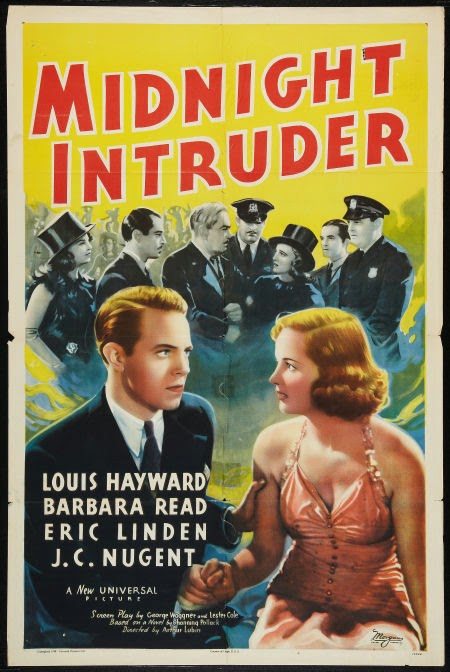
25. Midnight Intruder (1938)

Delightfully odd comedy owing to the presence of Louis Hayward (And Then There Were None, The Man in the Iron Mask and House by the River) who is genetically incapable of not being disarming and classy. The mistaken identity premise is strong and Hayward is so likable, it's easy to overlook all the crimes he's committing. The ending is smile-inducing and surprisingly heartwarming despite tying up all loose ends in a very credibility-stretching fashion.

24. Stranger at My Door (1956)

The great Skip Homeier is a bad-ass outlaw on the run who takes refuge with a minister (Macdonald Carey) and his young wife (Patricia Medina) in yet another quality William Witney western. The somewhat melodramatic film could have easily turned campy as Carey attempts to save Homeier's soul and Homeier puts the moves on Medina but Witney manages to steer clear of this. The film features a fantastic action sequence with a rampaging horse unlike anything I've ever scene where even the family dog attempts to subdue the wild colt by hanging from its bridal with its teeth. The ending is patented 50's feelgood, but as with most of Witney's work, his action is solid, the tension is well sustained and the pacing fast. The man just didn't make dull films.

23. Moonfleet (1955)

A mix of Robert Louis Stevenson and Charles Dickens, Fritz Lang's Moonfleet is an enjoyable, visually pleasing adventure about an orphaned boy sent to live with his ne'er-do-well uncle played by Stewart Granger. I've never met a CinemaScope film I didn't love and despite being shot in Eastman Color, it looks lush. The supporting cast features some of my favorite character actors including George Sanders, Joan Greenwood, Viveca Lindfors Alan Napier, Jack Elam and Skelton Knaggs.

22. Captain Clegg (1962)

A non-horror Hammer film that's another visually striking adventure with some great, unforgettable imagery involving a scarecrow and some horse-riding skeletons. The scene the above poster is inspired by is certainly the money shot of the film, but it is dispensed with at the outset and the real highlight, being Peter Cushing's performance, comes to the fore. A young, dashing Oliver Reed is also on hand as is his buxom love interest played by Yvonne Romain, but it's Cushing's character that propels the story and his charismatic performance that makes the movie as well along with strong supporting cast.

21. The Raven (1935) 

Bela Lugosi's hand wringing evilness is the draw of this Universal horror picture as he menaces Irene Ware's body and messes with Boris Karloff's mind. The storytelling is fairly straightforward and its not as cool in atmosphere as Ulmer's, The Black Cat, but Lugosi gives one hell of a performance.

20. Aventurera (1950)

A Mexican "rumberas" or cabaret melodrama with some wildly over-the-top moments, it stars the absolutely captivating Ninon Sevilla who acts, sings and dances up a storm. The film can certainly be enjoyed for its turned-up-to-11 campiness, but its surprisingly well-crafted look is a testament to the golden age of Mexican cinema. Sevilla will convert even hardcore haters of musicals into fans.

19. Robinson Crusoe on Mars (1964)

A Byron Haskin sci-fi film that is anything but the cheese-fest I was expecting. Instead, it's an earnest, gripping survival tale with some great Technicolor landscapes shot by The Searchers cinematographer, Winton C. Hoch.

18. The Haunting of Julia (1977)

Based on the Peter Straub novel, Julia, the film is a subtle, slow burn, ghost story with an excellent performance by Mia Farrow. It has the emotional character depth and strong back story of Roeg's Don't Look Now and the creepy believability of The Changeling. The effective third act pays off the gradual building sense of unease quite well with an ambiguous denouement that somehow manages not to cheat the viewer out of both an emotional and rational satisfying conclusion.


17. Return from the Ashes (1965)
Return from the Ashes is a well photographed black and white thriller about a concentration camp survivor who returns home to her husband but finds things have changed. Ingrid Thulin and Maximilian Schell are excellent as the leads and the story is mostly unpredictable. Fans of the director, J. Lee Thompson, may remember him as the filmmaker of various trashy Charles Bronson flicks like Death Wish 4 or of the last two Planet of the Apes sequels. However, his early career was pretty darn classy with films like Ice Cold in Alex, The Guns of Navarone and the original Cape Fear. Return from the Ashes definitely deserves to be mentioned along side these films as one of Thompson's best.

16. I Don't Want to Be A Man (1918) 
Comedies where women try to pass themselves off as men often fail to convince as the gender-bending actresses quite often appear and behave nothing like a male but supposedly fool other characters in the story (looking at you, Just One of the Guys). In Ernst Lubitsch's, I Don't Want to be a Man, lead Ossie Oswalda is able to transform from a spunky, rebellious, attractive female to a soft looking, charming, boyish male with only the aid of a top hat, tails and a short-haired wig. Instead of acting overly masculine and aggressive, Oswalda actually tones down a bit when impersonating a male but still manages to hang on to her amazingly charismatic presence and she physically sells the character quite well.

15. Targets (1968)
Peter Bogdanovich took a hodgepodge of seemingly disparate elements handed to him by Roger Corman and made an engrossing, prescient film about a mad sniper and an aging horror icon. I expected Boris Karloff to have just a throwaway type cameo, but he plays a fully realized, and at times, surprisingly humorous and endearing character that I was actively behind at the end. The sniper scenes are very tense and unsettling and are smoothly broken up by the lighter Karloff moments.

14. Cash on Demand (1962)

Another film that proves Hammer can operate well outside of the horror genre. People who aren't already fans of Peter Cushing will become instant converts after watching this riveting heist film. Cushing perfectly plays a slightly tyrannical, uptight, patrician bank manager who's character slowly and believably gets humanized over the course of the story. It's an amazing transition executed by the brilliant script and Cushing's magnificent performance.

13. Tension (1949)

Richard Basehart stars as a meek pharmacist married to a way-out-of-his-league femme fatale played by the amazing Audrey Totter. Totter is so good as the cuckolding vixen, viewers will want to choke her out on Basehart's behalf long before he begins planning her murder. Barry Sullivan and radio great, William Conrad, have some great chemistry as the investigating flatfoots and sell their partnership well in some subtle but humorous moments.

12. Nausicaa of the Valley of the Wind (1984)

I've seen all but one of Hayao Myasaki's featuring length films, and this stands as the most well-written, coherent and thematically sound of them all. Had he the animation experience, skills and artistry he would later display in films like Spirited Away and Princess Mononoke, doubtless this would be considered his best. Nevertheless, it's still a beautifully rendered piece with a strong female lead role and an engaging adventure
.
11. The Day the Earth Caught Fire (1961)
Brilliantly written, character driven science fiction out of the UK. It's cautionary global climate change tale is just as relevant today but it's the whip-smart, realistic characters with their everyday problems that really engages and anchors the picture. Edward Judd, Janet Munro and Leo McKern are excellent in the lead roles and deal the fast, snappy dialogue like nobody's business.

10. The Tunnel (1935)

The extreme financial, technical, physical and psychological difficulties of taking on a monumental project are explored in another intelligently written science fiction story out of the UK. I was really impressed at how serious the filmmakers took the subject matter and how in depth the story was. Richard Dix, who was so memorable in Val Lewton's, Ghost Ship, does another amazing job with a character who is obsessed in a far different but much more admirable manner. The special effects and sets are quite skillfully executed as well and add a nice steampunk flavor to the film.

9. The Naked Kiss (1964)

Sam Fuller brings his gritty, cigar-chomping directorial style while Constance Towers brings her wig and high heels to this pulpy melodramatic delight. If the opening scene doesn't rope you in, nothing will. The jaw-dropping twist, set up so well by Fuller, is one for the ages and I never saw it coming.

8. The Set-Up (1949)

Lean, real-time sports-noir superbly directed by Robert Wise that ranks among the best boxing films. Robert Ryan is great in the lead as an aging boxer who won't get out of the game even though no one believes in him.

7. Raw Deal (1948)
 
Very atmospheric, fast-paced Anthony Mann crime noir that utilizes a theremin during Claire Trevor's narration to surprisingly good effect. Raymond Burr nearly steals the movie as the short-fused boss antagonist and Ireland was strong as his henchman but I really loved Trevor's character who was so much more sympathetic than the average gun moll.

6. Gates to Paradise (1968)
A very nicely structured script with twisty stories told in flashback by various young, medieval characters making a pilgrimage to Jerusalem. Lionel Stander is surprisingly believable as a monk and former crusader who joins the children and soon discovers they have ulterior motives for making the trip. The filmmaking was solid by Academy Award winning director Andrzej Wadja but it's the strong plot and thematic elements from Jerzy Andrzejewski (Ashes and Diamonds) that makes the movie work well.

5. Dr. Mabuse: The Gambler (1922)
Fritz Lang's 4 1/2 hour origin story of the Dr. Mabuse character who was one of the first super villains in cinema. Rudolf Klein-Rogge owns the screen as the mind-controlling, megalomaniac master-of-disguise.The film may test patience due to its length and silent format but it really needs to be seen to fully appreciate the subsequent Mabuse films.

4. Dementia (1955)
Heavily influenced by German expressionism and certainly influential on subsequent filmmakers, Dementia is a cool, fever dream concerning a young woman's late night sojourn through the bowels of an anonymous city. Although very obvious in both its storytelling and psychological contrivances, it nevertheless has a hypnotic quality that sustains it throughout and was far ahead of its time with the Lynch-like, off-kilter characters, settings and moments.

3. The Testament of Dr. Mabuse (1933)
The visual flair Fritz Lang demonstrated in M and Metropolis is on full display in this follow up to his silent film, The Gambler. Whereas Rudolf Klein-Rogge's performance was the main attraction in that film, Lang completely dominates this one with his exceptional style. The story has elements of crime, adventure, even horror and is a lot of fun in addition to being an artistic masterpiece.

2. The Doll (1919) 
Ernst Lubitsh again teams up with Ossie Oswalda in an utterly charming, silent, romantic comedy about a young woman who poses as a life size doll and winds up falling for her would be owner - a young heir who's attempting to escape marriage. The supporting characters like the monks, the young apprentice and the doll maker are almost as enjoyable and wittily crafted as Oswalda's and make the film a thoroughly enjoyable, knowing romp from start to finish.

1. The General (1926)
A silent, civil war-set, chase comedy starring Buster Keaton as an engineer trying to get both his train and his girl back. The pacing of the movie never flags, quite rare for a silent film, due to the effective blend of action and comedy. The set pieces on the train are jaw dropping with Keaton making the most difficult stunts look easy and humorous. The best comedic moments, however, occur between Keaton and co-star Marion Mack who plays his hapless, slightly dim girlfriend, Annabelle Lee and had me laughing out loud consistently. Not only is The General my best first time watch of the year, it has jumped to the top of my favorite films.


Wednesday, November 12, 2014

Two Shadowy Burglars


Above are two noir-ish movies about burglars made within four years of one another that are nevertheless characterized by some striking differences that make each well worth watching. One was made by a very experienced, well-known B-movie director in the latter half of his long career and is among his best work. The other was a first time effort of a fledgling director and it may have been his finest hour. Both star character actors with familiar faces who perform well in the lead roles. Both have much more style than they should given budget constraints. And both make me long for the days of cool black and white films.

Paul Wendkos will likely be remembered by most as the director of the very popular 1959 movie, Gidget, with Sandra Dee along with its subsequent sequels, Gidget Goes Hawaiian (1961) and Gidget Goes to Rome (1963). Growing up in the 60's and 70's, I remember his name from the multitude of cool television shows he directed like The Untouchables, The FBI, I Spy and The Invaders as well as some of the more memorable made-for-TV movies like Terror on the Beach, The Legend of Lizzie Borden and The Death of Richie. Oddly his theatrical film work post-Gidget primarily consisted of war movies and westerns. For example, in 1969, he shot the first of two very good Euro-western hybrids in Spain, Guns of the Magnificent Seven (the third sequel to The Magnificent Seven). Easily the grittiest and most action-packed of the follow-ups in the series, the Italian-style westerns' dusty, brutal influence on Wendkos can clearly be seen. Likewise with his underrated 1971 Mexican revolutionary western starring George Peppard, Cannon for Cordoba, the Euro-western influence is very evident.
As Wendkos's theatrical movie directing slowly began to peter out in the mid-seventies, his continued success in made-for-TV movies insured his permanent residence in that medium. In 1976, he would direct his last motion picture, the utterly forgettable crime comedy, Special Delivery with Bo Svenson and Cybil Shepherd, and one year later he would helm the critically acclaimed drug awareness drama The Death of Richie with Ben Gazzara and Eileen Brennan thus sealing his TV career fate. Ironically, twenty years prior, Wendkos had made the best theatrical film of his career in his directorial debut.


The Burglar (1957), opens in such an unorthodox manner with Movietone-like newsreel footage from around the world, I momentarily thought I was watching the wrong film. But it's just a smart prologue to introduce the target of the burglary, a wealthy, phony spiritualist who appears in the last, human interest segment of the newsreel. As the scene cuts to the theater where the footage is being played, the titular character, Nat Harbin (Dan Duryea) is introduced watching the screen intently. It's a clever, efficient set-up that plunges the viewer right in just before the opening credits. It not only reveals the two major principles in the heist, but shows the victim as an unsympathetic con-woman and puts the viewer quickly in Duryea's corner before anything is even known about his character.


The first act of the film involves the introduction of the crew, the planning and execution of the heist and the complications that ensue. David Goodis, who wrote the screenplay based on his novel, wisely front-loaded the suspenseful and engaging aspects of the story and saved the character development for the post-burglary second act. In it, the complex relationship between Duryea's character, Nat, and his ward/accomplice Gladden (Jayne Mansfield) is explored. Though Nat has ambivalent feelings towards Gladden due to a pledge made to her father to take care of her, she is also a member of the crew. Duryea's character is stuck in the paradoxical position of trying to safeguard Gladden, but having a job and life that is detrimental to her. To complicate matters further, halfway through the story, Gladden professes her love for Nat, something that comes as no surprise to him, but is not reciprocated, at least not in the same way.


Though the middle act grinds out some necessary character development and introduces an additional female character that slows things up, the last act really brings it with Nat and Gladden's push-pull relationship reaching its apogee, the police closing in on the gang, and an unknown party, who has been stalking the crew, finally entering the picture. There's a lot of nice symbolism including the ending where Duryea and Mansfield's characters literally wind up in a carnival funhouse version of hell.


Duryea gives maybe his best, late career performance as the conflicted, world-weary, professional burglar. I recently re-watched him in the Audie Murphy western, Ride Clear of Diablo, where he plays an audacious, loose cannon gunfighter who could not have been more different from Nat, yet in both films Duryea's screen presence and skill are undeniable. The surprise though comes in Mansfield who was a better actress than the Monroe-wannabe stereotype with which she got tagged. It's a shame she didn't get more roles like this and The Wayward Bus where she plays serious, wiser-than-her-years characters who have some depth to them. Oddly, it was Mansfield's rise to stardom as the ditzy bombshell that shook this film loose for distribution as it had been languishing on the shelf for a couple of years. The two other members of the burglary crew are solid as well with comic actor Mickey Shaughnessy playing the sweaty fat bastard, Dohmer, who has eyes for Mansfield and German actor Peter Capell from Sorcerer and Paths of Glory as the intelligent but nervous, Baylock.


While the acting and writing are good, it's Wendkos' direction, editing and symbolically effective locations that really make the film a standout. In one scene, the emotionally trapped Duryea is shot through a jail bar-like bed headboard. In another, Mansfield's sexual isolation is exemplified by a distant overhead shot of her alone in the bedroom. Near the end, Duryea takes refuge in a remote shack across an empty marsh from Atlantic City where Mansfield's character resides. Again and again Wendkos effectively uses shots to convey the emotional state of his characters.


The shortcomings of the film mostly fall within the sluggish second act where Nat's allegiance to Gladden and his vow to her father are explained one too many times. The Martha Vickers character of Della seemed awkward and shoehorned into the plot for just one purpose towards the end. Also, the effort to keep the identity of the stalker a secret gets a little much towards the end and an earlier reveal could have had more impact than dragging it out.
Overall, considering the modest $90,000 budget, Wendkos made an imaginatively shot and engrossing late-cycle crime noir. Despite being his first film in a 40+ year career, it is likely his most artistically sound.


***

Dubbed a "forgotten master" by Quentin Tarantino, William Witney began his directing career at the age of 21 for Mascot Pictures which would later merge and become Republic Pictures. Although best known for his serials and westerns - the Roy Rogers singing cowboy features in particular - it's Witney's diverse range of genre films that prove most interesting. Everything from gangster pictures (The Bonnie Parker Story, City of Shadows) to juvenile delinquent dramas (Cool and Crazy, Young and Wild) to military action (Paratroop Command) to steam-punk (Master of the World) to blaxploitation (Darktown Strutters), Witney dipped his toe into a lot of subgenres. Although modestly budgeted efforts with limited resources and locations, Witney's films are decently paced, well photographed stories with some occasionally surprising style thrown in and usually feature some superb action set pieces. I know Mr. Tarantino is sometimes prone to be a little hyperbolic now and again, but in this case he's spot-on as Witney's 1961 espionage crime thriller, The Cat Burglar, can attest.


The film gets right down to business with the titular burglar, played by Witney-regular and future Combat! co-star, Jack Hogan, breaking into an anonymous apartment. Hogan, who's character is also named Jack, is accompanied by the jazzy, base-heavy, hepcat stylings of the film's music composer, Buddy Bregman giving the opening a very cool Playboy After Dark feel. Jack gets interrupted during his burgle by the beautiful tenant, Nan Baker, played by genre stalwart June Kenney (Attack of the Puppet People, Earth vs the Spider, Teenage Doll, and Bloodlust!). Nan has just returned to the country after picking up a briefcase containing a notebook for her boyfriend in Mexico. Fortunately for Jack (and all the male viewers), Nan decides to take a shower and leaves her valuables along with the briefcase on the dresser where Jack steals it before exiting. Unbeknownst to both Jack and Nan, the notebook contains secret missile plan formulas that Nan's boyfriend, Alan (John Baer) and his thuggish, foreign agent buddies are waiting to receive. Complications ensue.
Typical of Witney's work, The Cat Burglar is another low-budget expectation breaker with a surprising amount of attention to detail. For example, his shot set-ups and composition are pretty amazing given his limited time and resources and maximize the storytelling visually. In the ground level shot below, Nan's character goes looking for a bargain basement private investigator in a seedy flophouse:


In the next scene, she has a rather uncomfortable meeting with a corpulent detective, appropriately named Muskie (played by the incredibly awesome Bruno VeSota), in his unkempt room:


Later, the tough, foreign agents lay down the law to Nan's boyfriend, Alan. This shot is framed through the thug's arm while he stands threateningly over Alan.


When the thugs initially catch up to Jack, the visuals partially play out in a mirror:


And lastly, in the climatic warehouse scene, Witney brings on the light and shadow:


The screenplay was written by legendary character actor Leo Gordon and is direct and to the point but still better than it needs to be. Gordon, who is immediately recognizable as one of the great screen tough guys, surprisingly wrote over two dozen scripts for movies and television including The Wasp Woman and Attack of the Giant Leeches. Much like the latter two films, Gordon takes some time to flesh out the lead, Jack, and throw in some colorful side characters while still keeping the story moving. Unlike Duryea's character in The Burglar, Jack is a terrible amateur thief who lives in a cheap, trash-strewn motel room he can't afford. The owner/manager of the motel, Mrs. Prattle (Billie Bird), who pretentiously insists in white trash fashion on pronouncing her name pray-tell, is constantly busting Jack's chops for the rent.


The cast is made up from some of my favorite character actors from American International Pictures and Republic Pictures including Hogan, Kenney, and Baer as well as Gene Roth, Gregg Palmer and Bruno VeSota. The experience and natural presence of these actors goes along way in filling in the characters in the limited time they have on screen. Actors like Roth and VeSota don't have to do a lot of emoting to get across what their characters are all about, it's easily inferred by their mere presence.


The film does have its share of flaws like the character of bland Nan who has to be the most gullible person on earth not to smell a rat early on. Also, the music is good until it's used for comic stings or to denote danger at which point it becomes cartoonishly overt. Some of the street locations look less than cinematic and seemed like they were grabbed just to link two scenes. However, the ending warehouse shootout makes up for all sins because if there's anything Witney excels at in particular, it's action.

Comparing the two burglars, I'd have to say Wendkos' film has much more depth of character and emotional substance than Witney's. And while Witney has some moments of directorial flare as noted, Wendkos does an exceptional job throughout his feature. It's a little unfair to compare the lead actors who are in very different roles but Duryea owns in his hangdog performance whereas Hogan does just a passable workmanlike job in a much less ambitiously scripted part. With regard to pacing, Witney's moves much quicker but he does hold an advantage with a run-time that's nearly 25 minutes  shorter. Lastly, Wendkos' film feels much more cinematic and noir-ish than Witney's which could have passed for a very well-shot episode of television. Ultimately, Wendkos' The Burglar is the better, meatier steak but Witney's is still a tasty burger.

Scores:
The Burglar 7.75/10
The Cat Burglar 6.50/10