Monday, October 21, 2013

Proto Meta Mega Horror


It was meta decades before Wes Craven's Scream. It was a loving homage to the horror genre years before Joe Dante's Matinee. It featured monster-battling fanboy protagonists long before Fright Night, Popcorn or even Neon Maniacs. Hell, it even had a 13-year old Fred Dekker as a fan extra in a convention scene. And it's gone virtually unnoticed by everyone, including me - a horror fan, former Bay Area resident and one of the few people around old enough to have watched John Stanley on Creature Features back in the day.

***

For October, I decided to watch nothing but vampire movies all month long as an excuse to revisit some classic favorites, maybe find some obscure gems, and hopefully, reassure myself the sub-genre still had something to offer. Over two dozen movies in, after pulling a Bob Kelljan hat trick with Scream Blacula Scream and his two Count Yorga movies, and suffering through two incredibly amateurish pieces of homemade junk called Just the Vampire Hunter and Vampire of Quezon City, I was beginning to despair. Sure, I had revisited the great 1931 version of Dracula and discovered the sequel to Vampire Hunter D to be even better than the original, but had yet to be rewarded with that special kind of off-the-radar film often found in these sub-genre scavenger hunts. However, I soon stumbled upon a movie that, although not great, was nevertheless made with the love that can only come from a true fan of the horror genre.


1977's Nightmare in Blood captured my attention at the outset with what looked to be the climax of a Hammer film featuring a fight between a vampire hunter and his quarry. As the camera pulled back on the action and the shot switched to the inside of a movie theater, where the projectionist was then killed, I realized I was seeing one of the great, unsung meta moments in horror movie history. And if that wasn't self aware enough, one of the titles on the theater's marquee was the name of the film I was currently watching. Suck it, Craven. The film continued on from there to be an outright love letter, not only to the horror movie genre, but to horror comics and conventions as well. At a time when conventions were in their infancy, comic books were dime-a-piece disposable rags and people who loved horror films were considered weird or disturbed, Nightmare in Blood, was an unabashed, self-aware, prescient, mash note to the fans.


Directed by former Bay Area KTVU Creature Features host, John Stanley, Nightmare in Blood, wears its horror-loving heart on its sleeve, and although the references may seem obvious to even casual fans, it feels so good to see and hear them dropped throughout the entire film. From the wall to wall movie posters, to a horror comic history slideshow primer, to mentions of Price, Lee, Lugosi and Karloff, it never grows old or gets laid on too thick. There's a humorous undertone to the film, but it's all in the spirit of fun and entertainment which is ultimately the movie's message.


The story is set at a San Francisco horror convention and involves three organizers, a Vincent Price-like icon, a horror-hating film critic/crusader, a zen-like comic book store owner and a Jewish vampire hunter. It's not a spoiler to reveal that the horror movie icon, Malakai (played with Price-like gusto and appropriate method diva-ness by Jerry Walter), is actually a vampire who intends to kill while at the convention with the help of his pseudo-publicist henchmen, BB and Harris. The convention organizer characters are refreshingly mature, grown-ups instead of the typical obnoxious teens that are ubiquitous in modern horror and are played by Barrie Youngellow as Cindy, Dan Caldwell as Professor Seabrook and John Cochran as Scotty. The best known actor in the film is Youngfellow, who co-starred in the long running 80's sitcom, It's a Living and did a lot of guest spots on shows during the 70's. She's quite likable and spunky in a role she won out over Suzanne Somers. While Youngfellow and Walter are the class of the ensemble and clearly the most experienced, there are fun, if unpolished performances put in by others as well including Justin Bishop as the anti-horror crusader, Dr Unworth.


The production is a low budget, indie affair and that's where its achilles heel is evident - the film looks like an inexpensive mid-70's production with cheaper film stock, unreliable lighting, poorly looped ADR and the occasional rough editing. The tone is whiplash-inducing with characters like a dopey theater usher (complete with his own goofy theme music) occupying the same cinematic space with a grim story about the holocaust and some brutal murders. The pacing is similarly uneven and bogs down at times with an ending that moves maybe too fast. The film does benefit mightily though from many of the San Francisco and Oakland locations like the old coastal artillery emplacements in the hills near the Golden Gate Bridge, the Rialto theater and the KTVU studios. The script by Stanley and Kenn Davis is very knowing and not only includes all kinds of hat tips to horror, but is humorously prescient when it derides its critics in the form of Dr Unworth, the convention protester/crusader and author of the fictitious anti-comic book tome "The Rape of the Young Mind". Also way ahead of its time was the inclusion of Jedi-like/comic book guru character, Gary, who drops wisdom like, "Men will turn to ashes, comics will prevail."


All in all, its a very flawed film, but its heart is in such the right place and it got there so long before anyone else, it's very difficult not to forgive the missteps and feel a tremendous amount of affection and respect for it.
Score 6.75/10


Thursday, October 3, 2013

Cherry picking The Fabulous Forties


I recently polished off Mill Creek's Fabulous Forties 50 movie box set and was quite surprised by the lack of filler or outright duds. That's not to say it didn't benefit from a complete absence of mediocrity as evidenced by the presence of films featuring bland fictional characters like Dr. Kildare, The East Side Boys, Dick Tracy and Ronald Reagan, but there were a surprising number of near classics and interesting anomalies. So with apologies to Kim Jee-Woon, here are The Good, The Bad, The Weird and The Honorable Mentions of The Fabulous Forties set...

The Good

Guest in the House (1944) 
My love affair with director John Brahm continues in this unsung little psychodrama that was made just prior to his masterpiece, Hangover Square. The main attraction is an over-tightly wound performance by a young, scrumptious Anne Baxter as Evelyn Heath, the patient/romantic interest of Doctor Dan Proctor (Scott McKay). As the story opens, Doctor Dan has brought Evelyn home to meet the family for the first time as a prelude to marriage. However, an early indicator that all is not well in Evelyn-world comes when a young female relative attempts to stroke Evelyn's cheek after complimenting her on her beauty and Evelyn recoils in revulsion and yells at the child not to touch her. Nope, nothing wrong here at all. The story drags on a bit early as characters are introduced, but once the machinations kick in by Baxter's character, the fun begins. Ralph Bellamy, who was one suave gent in his prime, plays the elder, married brother of Dr Dan and spends the movie trying to deflect some very unwanted attention from Evelyn. The melodramatic aspects of the film reaches campy levels on occasion but Brahm's stylish, atmospheric direction keeps it from spinning out of control and almost makes you forget the entire film takes place only in the family's house.
Score 7.5/10


The Strange Love of Martha Ivers (1946)
Previously on my list of shame of unseen greats, the incredible cast alone merits an immediate watch but this is also an excellent blend of noir and melodrama with an intelligent script by Robert Rossen. Both Kirk Douglas and Van Heflin take on uncharacteristic roles - normally they would have been given each other's part - but they're both still outstanding. Lewis Milestone's direction is competent but it's the script and actors that make this one a classic.
 Score 8.0


The Red House (1947)
This is an understated American gothic thriller with some disturbing psychosexual overtones that stars Edward G Robinson. Despite Delmer Daves very perfunctory and uninspired direction, the film works mostly because of the taboo undercurrents in the script that exist between Robinson's farmer, Pete, and his adopted daughter, Meg, who is played with doe-eyed earnestness by Allene Roberts. Roberts is very good in this role and spends a great deal of the movie looking wounded with tears threatening to spill out of her eyes at any given moment due to her character's confusion over Pete's behavior. It's surprising that such a young inexperienced actor is able to hold her own when sharing the screen with Robinson. Unfortunately, the same can't be said for Lon McCallister who gets blown off the screen repeatedly whenever he's in a scene with Robinson and is easily the weakest presence in the film. Julie London and Rory Calhoun co-star in early roles and are both quite enjoyable as the bad boy and wanna-be bad girl. And finally, the great Judith Anderson plays against type as the compassionate sister of Pete. The movie does well in building up the mystery and tension between Pete and Meg and is surprisingly frank at one point when Anderson's character asks Meg if Pete has put his hands on her. Strong stuff for 1947. There were problems, however, in the creation of atmosphere. The day for night shooting was readily apparent to the point of distraction and there were wasted opportunities at the end when we finally get to the red house and it just doesn't look that imposing or scary. Overall though, the film is an engaging old-school, gothic melodrama with really good performances by Robinson and Roberts.
Score 7.25


D.O.A. (1950)
Fast-paced noir that never takes its foot off the pedal as Edmond O'Brien seeks to find out who poisoned him and why. Simple, straightforward storytelling with the only flaw being an annoying slide-whistle when the ladies walk by.
Score 7.5


The Last Chance (1945)
Believable story involving two WWII POWs who escape from a train in Italy and attempt to make their way to the Swiss border. The realistic nature of this one caught me off guard, but unlike Rossellini's War trilogy, there are some Casablanca-like sentimental moments that will bring a tear to your eye as well. The fact that there are no big recognizable stars is a plus and the settings seem to be the real locations, again echoing Rossellini's work. It misses a couple of opportunities to go very dark, but is nevertheless far from the average feel-good war movie of the era. Films like this are the reason I buy Mill Creek sets.
7.75


The Bad

This is the Army (1943) 
I know it's not fair to pick on a propaganda film from this era whose heart's in the right place, but this was one of the most overly sentimental, dull, unimaginative and yet overblown productions I've seen. Ronald Reagan, who may have had charisma for a politician, is a complete charm void as an actor and helps scuttle the film towards the end that features a smarmy romance and a climactic musical number involving a bunch of army guys marching around to an uninspired Irving Berlin tune. The shockingly offensive minstrel number (I know, it was a different time, but when one of the characters asks rhetorically "Who says minstrel shows are outdated?" you know stuff like this was way past its expiration stamp even then.) just one more nauseating thing to be endured in this wildly dated affair. I can get on board with a little blind patriotism and can even overlook a some era-appropriate racism, but wow. Ironically, the only real entertaining musical number comes from Joe Louis' African-American pals who unfortunately have to display their considerable skills against a stereotypically offensive mural backdrop.
Score 3.0


Cheers for Miss Bishop (1941)
I usually get annoyed when people criticize a film for what it isn't, but I will now proceed to do just that. However, I do think a film about a dedicated teacher should spend more than a few seconds showing that person actually teaching or interacting with her students in some meaningful way. Films like Stand and Deliver and Mr Holland's Opus show their respective teachers making a connection and actually teaching. In Cheers for Miss Bishop, the school and students are merely a backdrop for the titular character's love life. It's just a given that she's a great teacher but we never see why and it seems unrelated to her personal life to a large degree. I have nothing against romantic movies but this one seemed a bait and switch focusing solely on the soap opera aspects to the exclusion of all else. Plus, the character is just not that engaging nor her affairs that intriguing to hold interest for a story which spans almost her entire adult life. Martha Scott as the lead is fine, I blame the lazy, Harlequin script on this one. 
4.75


The Town Went Wild (1944)
Utter predictability is death to comedy and I could see every comic beat coming a mile away in this 40's screwball picture. The movie plays it safe as well teasing the audience with a possible incestuous relationship we know will never materialize. The characters are overly broad and the situation not as clever as it thinks. Even my love for Edward Everett Horton didn't help me through this groaner. The only joke punch that landed with me was the lodge member with the incredibly huge moose head-hat.
Score 4.0

The Weird

Li'l Abner (1940)
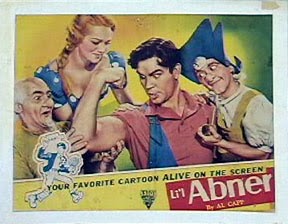
I was ready to hate on this thing like no one's business when I began watching. I'm not a fan of any of Al Capp's work and a live action version of dumb, grotesque hillbillies cavorting around the fictional land of Dogpatch seemed anything but appealing. But a weird thing happened about halfway into this, I actually started to enjoy and even admire it. Like Altman's Popeye, the film meticulously recreates the cartoon's world in every ridiculous aspect and the actors go for broke as well in their portrayal of the incredibly goofy characters. Mona Ray and Johnnie Morris as Li'l Abner's parents, Pansy and Lucifer, are particularly good and weirdly convincing. Though the movie is as dumb, obvious and predictable as its source material, it nevertheless has a certain charm and entertainment value.
5.75


That Uncertain Feeling (1941)
Burgess Meredith steals married Merle Oberon away from her husband, Melvyn Douglas. That's how weird this Ernst Lubitsch comedy is. Oberon's character, Jill Baker, gets convinced by her psychiatrist that she's bored with her marriage and she decides to have a fling with snooty artist Alexander Sebastian (Meredith). I'm not entirely sure what the message of the film was suppose to be (having a fling with a short pretentious snob will make your marriage stronger?) but I kind of liked its nonsensical wackiness. Plus, the leads were really enjoyable particularly Oberon who never fails to captivate.
Score 6.5


The North Star (1943)
This one is strange in a variety of ways. First, it's an American studio propaganda film with Russian characters as the heroes. Second, it begins as a very lighthearted, feel-good musical before the Nazi's show up and put the brakes on the fun. Third, it was later deemed subversive by The House Un-American Activities Committee (ya, but weren't we allies with the Soviet Union when the film was made?) 
Setting aside the over romanticization of the peasant's lifestyle in the movie, it is a fairly accurate and rare take on the Nazi invasion of the USSR. The self-imposed scorched earth policy and the examples of Nazi brutality actually did occur and I was surprised that this movie went there after starting off so light and breezy but it certainly made its point effectively. As far as the commie "subversiveness" goes, you really need to break out a large magnifying glass to see it. The only things I noticed were a brief shot of the hammer and sickle flag and one or two uses of the word "comrade". I think what probably irritated Tailgunner Joe and his boys was a reminder that we couldn't have beaten the Nazi's without the heroic Ruskies.
The quality of the film is well above average with some able direction by Lewis Milestone who also made All Quiet on the Western Front and the previously mentioned The Strange Love of Martha Ivers. The cast is solid also with Anne Baxter, Walter Houston, Dana Andrews and Walter Brennan in the lead roles. Although it falls victim to a bit too much sentimentality and a traditional-for-the-era ending, it's still a very interesting trip to a place and time rarely visited by western audiences.
7.0

Honorable Mentions


Pot O' Gold (1941) A poor but happy music shop owner moves to the city to help his rich but miserable uncle. Leading roles in movies like this were taylor-made for Jimmy Stewart. 7.0


 My Man Godfrey (1936) Mill Creek kind of cheated with the inclusion of a 30's movie in a 40's set but I'm glad they did as William Powell is very dry but likable and Carole Lombard is appropriately daffy in this enjoyable screwball comedy. 7.5


Shock (1946) Modest, somewhat predictable thriller, but when has Vincent Price ever been less than awesome? 6.75


His Girl Friday (1940) I can't stand Cary Grant, but Rosalind Russell steals this film and dominates throughout with her fast-talking and comic timing. 7.25

Wednesday, September 11, 2013

The Day the Clown Died


"It was bad, bad, bad. It could have been wonderful, but I slipped up."
-Jerry Lewis commenting on The Day the Clown Cried 

No cinephile among us can resist the lure of an obscure film. Whether it's rumored to be a masterpiece or epic failure, there's something irresistible about an unseen or rarely viewed movie. It's why new releases, no matter how critically panned, always get at least a few adventurous viewers. It's why old movies, no matter how commercially unsound, never fade away completely. Hardcore fans just love the road less traveled, even if it's purported to be bumpy.
Recently, I've been going through Edward L Cahn's directorial catalog focusing specifically on his prolific and diverse genre work from 1955 to 1962. In this 7-year period, he made just shy of 50 b-movies, mostly for AIP, including westerns, horror, sci-fi, crime and family dramas. Cahn's films will never be considered great, or even good, but they are expectation breakers that do surprise, albeit mildly, for their better than average pacing, structure and execution. What set his work apart from other run-of-the-mill low budget filmmakers of the era is his consistently solid technical skills. Despite his immense output, none of Cahn's efforts appear slapdash, muddled, padded or error-riddled as is often the case of cost-conscious genre films from this era. The stories are formulaic and somewhat predictable, but Cahn's It! The Terror from Beyond Space, which concerns a monster loose on a spaceship, predated Ridley Scott's Alien by two decades, and Invisible Invaders, featuring slow-walking, non-voodoo zombies beat George Romero to the punch as well. However, I think Cahn's biggest strength is his well-paced, lean and to-the-point style which probably stems from his early background as an editor on major productions in the twenties. There's often an efficiency in storytelling that occurs in Cahn's films that speaks to his directorial ability to pre-edit his work a la John Sayles. His technical gaffs are limited as well which is surprising considering the speed, quantity and inexpensiveness of these productions. Though the stories are often straightforward presentations of their given sub-genre and the budgets are limited, the quality of execution and streamlined style of Edward L. Cahn always makes his features eminently watchable and pleasantly engaging. To be sure, none of his films will ever make any 'best of' lists, including my own, but they continue to surprise by how terrible they aren't.


I have to be honest. When I see a single-digit number of user ratings in IMdB, especially for a film that's widely available on a streaming service, I am more than a little intrigued. A grand total of 5 people had rated Edward L Cahn's The Clown and the Kid before I got to it, thereby qualifying it as obscure enough to watch despite the fact that neither clowns nor boys are ordinarily my thing. On the surface, the film sounded syrupy and maudlin to cringe-inducing proportions. And I knew the extreme low budget-ness was not going to help matters. But Cahn beat my low expectations yet again with his simple, uncluttered storytelling and resourcefulness. Even though the movie does indeed brim with sentimentality, the director delivers an enjoyable, innocent, sincere drama that beats the heck out of any live-action stuff of a similar vein that Disney would do in the 60's. Michael McGreevey, who would later co-star in a lot of Disney television and movies, plays the titular kid, Shawn. Don Keefer, who plays Shawn's dad, is the early incarnation of Moko the clown. At the start of the film, Shawn and Moko are performing a sort of clown and pony show at a carnival when Shawn's dad decides to move to Texas due to his failing health so that Shawn can attend the same orphanage where clown/dad was raised. We know dad is not long for this world when his nitroglycerin pills make an early appearance. In 60's movie and TV convention, when you see the heart meds come out, the character taking them will be gone within three scenes one way or another. Moko-dad, who undoubtedly understood this rule, makes some early check-out preparations with Shawn while on their drive to Texas. This scene, which is certainly manipulative, never comes off as cloying even when Shawn asks permission to cry. A lot of the credit goes to the veteran character actor Keefer for his good sense of timing and ability to steer the scene emotionally. But the real star of the film, John Lupton, shows up only after Moko-dad has shaken off his mortal coil. In an interesting twist, Lupton plays escaped convict, "Pete", who stumbles onto Shawn and soon-to-be-discovered-dead dad when he tries to steal some food from their camp. Pete gently cons Shawn into accompanying him the rest of the way to Texas and father-son friendship ensues. Pete assumes the Moko role, more out of self-preservation than design, and he and Shawn seek out employment on the way to the orphanage. A female amusement park owner eventually enters the picture and there are kindly nuns plus a smart horse as well. It all sounds gag-inducingly sweet, I know, but Cahn keeps it from going outright schmaltzy and Lupton never panders with his performance. Lupton, like Keefer, was a journeyman TV and movie character actor with a substantial amount of experience. I was recently very impressed by him in Mark Stevens'  1957 underrated western Gun Fever in which he played a tubercular gunfighter turned miner who harbors a dark past. In The Clown and the Kid both Lupton and Cahn are better than the movie they are working on, yet neither uses it as an excuse to phone in their work. Maybe that's what I admire most about Cahn, despite having cheap tools and inferior material he still takes the job seriously and delivers an adequate product.

Score: 5.75/10


Thursday, August 29, 2013

Herz So Good


If you were browsing Netflix Instant last year and passed on viewing this film based solely on its incredibly generic title and tagline, I don't blame you. "What are you scared of?" isn't exactly the most conceptually brilliant marketing line and the name Darkness was used earlier in the decade in another haunted house film starring Anna Paquin. So it's completely understandable that someone would opt for something fresher sounding and original.  But let me retroactively try to entice you into tracking this one down by first offering a few screenshots...

*
*
*
*
*
*
*
*


The film, originally titled T.M.A. (and I have no idea what that stands for, yet it's still better than the unimaginative english release title), was directed by Juraj Herz who was part of the Czech new wave back in the late 60's. Herz's most critically acclaimed film, The Cremator, was made 40 years prior to T.M.A. and is a very unsettling look at a control-freak restauranteur and part-time mortuary employee who finds that he fits right into the late 30's Nazi party. That the protagonist (who is played beautifully by Rudolf Hrusinsky), appears a polite, unassuming, ever-smiling, pleasure loving, family man makes him all the more chilling as he increasingly rationalizes his growing megalomaniacal madness. The film is a brilliant understated work that reminded me thematically of Wolfgang Staudte's Der Untertan (Man of Straw) only with a much darker tone and the blackest of comedy leanings.


Born in 1934, Herz was obviously deeply disturbed by the Nazi occupation of Czechoslovakia during his childhood as it shows up in his work often, not only in The Cremator and his latest film Habermann, but in T.M.A. as well. In fact, the Nazi backstory wasn't in the original T.M.A. screenplay by Martin Nemec, but was subsequently added in by Herz and definitely elevates the movie to something more than the average haunted house tale.
The plot involves a Prague rock guitarist, Marek (Ivan Franek), who decides to return to his childhood home and start painting. This is probably not the greatest idea since he subsequently finds out his house has a worse pedigree than the one in Poltergeist and the townsfolk, with one notable exception of the local postwoman, are none to friendly. As Marek gets the house in order and begins painting, weirdness ensues from every quarter.
The film sports a solid Fulci-esque ocular intro intercut with Marek's band rocking out in a club. It also features some enjoyable sleaziness in the middle when Marek's bandmates visit him with a groupie in tow. Even the ending has a mystery twist, and if not for its haunted house aspects, the movie could be categorized as more giallo than horror. What kept me guessing and off balance, was the multitude of red herring characters and plot devices introduced in the first half of the film. There are creepy townies, a mysterious archivist, a one-eyed, asylum-dwelling woman, a man-tastic singer and her sleazy, party loving boyfriend/manager, a property where ritualistic human sacrifices were purported to have taken place, a house with the world's worst plumbing that was previously occupied by the SS, a haunted radio that only plays the Oh du lieber Augustin song and some gentle, spectral Down's Syndrome kids who appear intermittently. All of these elements may prove one too many for some, but Herz ties it all up at the end, albeit a little too neatly.
The direction is consistently strong and Herz is unafraid to move the camera around even going hand held when appropriate. He also mixes in some dutch angles, overhead shots and lens filtering, but sparingly, and never as an annoying gimmick that wears out its welcome as in much modern horror. There's an unnecessary gore scene in flashback near the end that felt inserted just for the sake of it and an unexplained disappearance of a body but otherwise, the film is a stylish and atmospheric horror/mystery.
For those whose only experience with Juraj Herz is T.M.A., I'd strongly recommend checking out The Cremator and his superb 1978 Czech adaptation of Beauty and the Beast:
 http://www.youtube.com/watch?v=UW519mpOlA8

Scores
T.M.A. 7.25
The Cremator 8.50
Beauty and the Beast 7.75


Saturday, August 17, 2013

Sunshine (Award) on my shoulder


Thanks to Dusty over at the Playground of Doom blog for throwing some light in my direction and nominating me for The Sunshine Award*. It's always a pleasure to receive such attention from a like-minded cinephile, outstanding writer and all-around, good egg.

10 Questions 

1. Favorite actor/actress who is not a household name?

Nick Damici from Mulberry Street, Stake Land and the upcoming Somos lo que hay remake. Damici, in addition to being a fine actor, has an old-school tough guy look very reminiscent of Charles Bronson or William Smith and is anything but the omnipresent generic pretty-boy of modern day cinema.


Émilie Dequenne - a Belgian actress who made an impressive debut as a desperate underclass working girl in the Dardenne brother's Rosetta and followed this up playing royalty in Christophe Gans' fantastic genre mash-up Brotherhood of the Wolf. She continues to mix it up nicely doing horror like 2010's, The Pack, mysteries like 2006's, Fissures and more serious stuff like The Girl on the Train from 2009.


2. Favorite Animal?

The California King Snake -


There are a lot of rattlesnakes in Shasta County where I live. However, there are none where I work and it's due to this guy, who is a natural predator of the rattlesnake, but not a danger to people. Thanks for keeping me safe on the job California King snake, you do indeed rule. 

3. Favorite non-alcoholic beverage?

Almond chocolate milk - mmm, low calorie and delicious.


4. Favorite music?

I've got pretty eclectic tastes which is probably why movie soundtracks take up the majority of my ipod space. Everything from Bollywood to 70's Italian genre cinema.

5. Favorite TV show? 


Robin of Sherwood (1984-1986)  The weird thing is I don't like any of the Robin Hood cinema adaptations at all. This Richard Carpenter creation did it right though by filming on location, using Clannad's music and throwing in just a pinch of mysticism for flavor. Plus, Ray Winstone is the coolest Will Scarlet ever. Yes, the cheap film stock is grainy as hell, but it's still enjoyable despite this and quite different than any other incarnation of the story.

6. Favorite sport?

Baseball to watch, bowling to play.

7. Movie that most people love that I dislike?

Gone with the Wind is so melodramatic but still incredibly dull and plodding. Inglorious Basterds was a tonal mess with a ridiculous climax and the most unbelievable WWII film ever made.

8. Favorite short film?

Suspicious (1994) An urban legend-like, shaggy dog story that works thanks to Michael Rooker. Don't believe the insanely low rating on IMdB, this short is solid.

9. Passion?

No doubt about it, it's film. I'm averaging about 700 a year and watch virtually no TV nowadays. I've been getting into a lot of older films of late and am amazed by how much quality stuff I still haven't seen.

10. Favorite soundtrack from 2013?

Haven't seen any films from 2013! However, my favorite soundtrack of all time is from The Good, The Bad and The Ugly. Bill and Ted's Excellent Adventure and Night of the Comet are two of the funnest pop soundtracks.

Blog Picks

There is no shortage of great movie blogs written, but the first two of the choices below are so good, they inspired me to start up my own humble effort.

  1. Hans' Quiet Cool is an intelligent, incisive and gloriously esoteric look at the heyday of European genre cinema. 
  2. Emily's insightful, humorous and very entertaining Deadly Doll's House of Horror Nonsense delves into some of the most obscure gourmet fromage horror films you've never heard of.  
  3. Brian's Rupert Pupkin Speaks features some great lists of forgotten movie gems by knowledgable guests and Brian himself.
  4. K.H. Brown's incredibly comprehensive Giallo Fever blog has covered about every giallo film ever made and many other Euro treasures as well. A great resource if you want to dig deep into the genre.
  5. Although the posts are few and far between both Dean Brierly's Fifties Crime Films and Sixties Crime Films are quality looks at under-seen crime films from these decades.
  6. The Euro-western genre is covered in extensive detail by Tom B. in Westerns... All' Italiana!
  7. A blog that's relatively new to me, but I love the choices of films reviewed thus far is Jeffrey Canino's Nessun timore.
  8. An old favorite, written by the Mill Creeps podcaster and GGtMC contributor Aaron is The Death Rattle blog.
  9. Mykal covers many of my favorite classic sci-fi films from the golden age at the Radiation Cinema! blog
  10. Another blog I'm new to written by a guy named Jeff who has outstanding taste in old movies (sounds familiar) is The Stalking Moon.
Thanks to all who take the time and make the effort to share their love of cinema. Some of the best movies I've viewed in recent years have been because of your writings.

*S.A. Rules -

Participation is strictly voluntary.
1. Include the award’s logo in a post or on your blog.
2. Link to the person who nominated you.
3. Answer 10 questions about yourself (use these or come up with your own).
4. Nominate 10 bloggers to pass the award on to.  (This is as much about sharing as it is about receiving.)  
5. Link your nominees to the post and comment on their blogs, letting them know they have been nominated.

Saturday, August 3, 2013

Clean My Shoes, Oscar Madison!


Wouldn't the 70's TV sitcom reprise of Neil Simon's The Odd Couple have been so much better if Felix and Oscar had been hit men? And wouldn't Henry Silva have made a much more interesting clean freak than Tony Randall? And wouldn't it have been great if they'd have had to go on a road trip together to France to rub out a potential mafia stoolie? Just think of the comic hijinks that would have ensued as an angry Silva frustratedly explained to an apathetic Klugman that he likes it clean just before they go in to kill a guy. What's that? You want to see such a show? Unfortunately, that version of the TV show never existed, but there was this little French film from 1965...


Based on the novel by Pierre Lesou, who also wrote the Melville adapted Le Doulos three years earlier, Je vous salue, mafia! (Hail, Mafia) is a serious, low key, existential trip involving two seemingly disparate hit men assigned to silence a potential mob informant in Marseille. Complications arise, however, when the mafia kingpin in jeopardy from the possible testimony is unexpectedly released from jail and calls off the contract. Ubiquitous 70's TV star, Jack Klugman, plays mafia soldier, Phil, who has personal reasons for wanting in on the hit and talks his way into the contract over the obvious disapproval of fellow button man and prospective partner Schaft (Henry Silva). The two men ultimately team up and fly to Paris to meet their contact (Micheline Presle) who has made arrangements to expedite the hit. Meanwhile, their target, Rudy Hamberg (Eddie Constantine), who has already eluded one attempt on his life, makes his own preparations.


I initially watched this film knowing only the title and that Silva and Klugman starred. I wasn't expecting much and the poor quality of the print I was viewing only served to dim any optimism. But by the end of the film, I was stunned at just how strong the story, atmosphere and characters were especially in the the last act which provides a truly sublime and fitting denouement to the proceedings. The plot is simple yet deceptive in its subtle execution. Developments that will serve as complications are casually introduced into the story in such an ordinary, slice-of-life fashion that their import can almost be missed amongst the banality. While the leads do everyday things like shave, bathe, read the paper and dine out, the plot still inches ever forward toward the inevitable. The stripped down, moody style of the film feeds right into this slow walk to oblivion with high contrast, stark, yet very bright, monochromatic photography, a crazy jazz soundtrack and a desolate rural setting in the final act. Silva and Klugman's hit men characters are the principle focus of the film and though they are anything but a squabbling Odd Couple, there is a fundamental difference in personal make up. Silva's Schaft is the erudite type as evidenced by his book loans to Klugman's Phil and his occasionally donned, thick-framed glasses. Despite admitting to speaking "not one word" of French, Schaft nevertheless uses the correct enunciation when giving directions to places like Dijon while Phil apathetically struggles with the foreign pronunciation. Phil, despite hailing from the same neighborhood in New York as Schaft, appears much less polished and more low class than Schaft by virtue of his bull-in-a-china-shop attitude, rumpled look and penchant for horse racing. Klugman's hangdog, schlubby physical appearance feeds right into this persona. There seems to be differences in personal philosophy between the two as well. At one point, Silva's character states simply "I like clean"  meaning he prefers the orderly, clear cut, structure and code of the mafia hit man. Klugman, who apparently disregarded the rules when he insinuated himself into the contract for his own reasons, doesn't appear to care about this, but nevertheless wants Silva's approval. This conflict between the two men causes an undercurrent of tension throughout the film that only surfaces in the beginning and near the end culminating in an almost Jules and Vincent-type time-out just before the hit when the characters stop and verbally hash out their differences. It's a climactic moment in the relationship that occurs just prior to the climax of the plot itself and serves its purpose well given how the story plays out.


There are some bumps early in the film including a few mediocre supporting performances by very minor characters, some choppy editing and a Manos-style, metronome-like section in an otherwise solid jazz score. The target's mistress and accompanying subplot were completely disposable as well. But these flaws were brief in duration, and believe me when I say, all is forgiven by the end of the final act when everything comes together perfectly to bring home one of the strongest and most satisfying endings I've seen in a crime film.

Score 8.25/10