Friday, April 18, 2014

Spock-blocked


Stop everything! Someone just complicated Spock and T'Pring's love life, but who did it? Here are a few clues...

He chauffeured for Harlee McBride's titular character in Young Lady Chatterley as well as for the Donald Pleasance baddie in Escape to Witch Mountain.


He sailed with this Guy in Captain Sindbad and played the flute for him in Damon and Pythias.


He portrayed a suave psychologist who owns the world's coolest car in The Psycho Lover.


He provided necessary Diversions in The Great Escape and in real life was friends with the star.


And, in Star Trek TOS, he requested the glory of the kill from his Romulan commander in Balance of Terror, and not only cuckolded the Enterprise's first officer big time in Amok Time, he was originally cast as Spock before Nimoy decided to take the role.


If you grew up in the 60's like I did, you could not escape his ubiquitous, guest-starring presence on TV. Usually portraying a troublemaking second tier henchman or villain in network genre fair, he was continuously popping up, even on the same show, in different roles. In Quinn Martin's original FBI  series alone, he played seven different characters in seven separate episodes during the course of its run. He also appeared in The Invaders, The Time Tunnel, The Fugitive, The Outer Limits, Combat!, Perry Mason, Hogan's Heroes, Batman, Mission: Impossible, The Flying Nun, I Spy, Lassie, The Man from U.N.C.L.E. and Daniel Boone to name just a few. But what he's most known for are his two guest roles on the original Star Trek series and a near miss with iconic fame. His name is Lawrence Montaigne.


How different would the universe have been if Leonard Nimoy had not exercised an option in his contract which allowed him to assume the part of Spock on Star Trek after leaving the Mission Impossible television series? Well, for one thing, Lawrence Montaigne would have become a household name. He had already been hired as the number one Vulcan by Roddenberry, but was bumped out of the part when Nimoy decided to eschew the IMF and join the Trek cast. Montaigne subsequently did get the pleasure of stealing Spock's fiancee as the rival Vulcan, Stonn, in the classic Amok Time episode, and nearly got to blow up the Enterprise as the upstart underling Romulan, Decius, in Balance of Terror, but missed the chance of becoming a cultural icon by a contract clause.


Despite this, or maybe because of it, I've always been a fan of Lawrence Montaigne and am always pleased when he shows up in a TV show to complicate things. Recently, I've been checking out Montaigne's film work which is as varied and interesting as his television gigs. He made many appearances in movies from the 60's on, the most notable of which was a co-starring role in The Great Escape as the POW, Haynes, aka 'Diversions'. Prior to this he acted in several Italian cinema productions including one of the more substantive peplums, Damon and Pythias (1962). Although, technically average, this sword and sandal movie is ambitiously scripted with themes of brotherhood and honor running throughout the story which give the film much more weight than is typically found in the genre. In addition, co-star Guy Williams and Montaigne look to be having an excellent time in their respective parts playing rogue-ish buddies who each discover a higher calling in life. Montaigne would act with Williams again a year later in the colorful Byron Haskin adventure Captain Sindbad. In it, he has a much more modest role but does get a scene to himself where he's menaced by fake crocodiles. One of his most substantial roles would come in the 1970 American thriller, The Psycho Lover. A prime example of exploitation cinema of the day, the film mixes giallo-like death scenes and plot twists with ample sleaze and a distinctly early 70's psychedelic atmosphere. Robert Vincent O'Neill, who directed the first two Angel movies and co-wrote the notorious Vice Squad, is the writer/director and delivers a much better than expected exploitation piece with Montaigne as the suave, playboy lead. He portrays a wealthy psychiatrist stuck in a bad marriage who has just begun treating a serial killer suspect. He decides to take advantage of this situation by manipulating the killer to his own ends. Although Montaigne gets upstaged a bit by the kill scenes, which are disturbingly realistic, he really gets to do a variety of stuff including a couple of love scenes.


Watching Psycho Lover and Damon and Pythias had me wishing Montaigne had returned to Italy and done a lot more genre work there as he definitely has a European character actor's mug (despite being Brooklyn-born) and some acting chops as well. He could easily have pulled off the tough cop or crook character in a poliziotteschi or giallo. On the other hand, if he had left the States, it would have deprived me of the pleasure of seeing him routinely complicate some protagonist hero's life on network TV. I guess things worked out for the best. Although he never put the beat-down on Tomas Milian or Maurizio Merli and never did get to kick Mr. Spock's tight ass, he did get the girl in the end, and that's all that really matters.


Sunday, March 30, 2014

The Wayward Adaptation


American author John Steinbeck wrote stories set mostly in the 1930's, and 40's with sharp social criticisms concerning the people, attitudes and situations of his day. Movie adaptations of Steinbeck's work have almost always been less than satisfying principally because they were products of the same time, usually being produced within a few short years after the publication of the novels, with all the societal, political, moral and code restrictions of the day diluting or outright excising their original message from the films. Attempting to make a movie about complex characters with underlying social criticism is difficult in the best of times, but near impossible in the early to mid-20th century, at the height of Steinbeck's popularity, in such a restrictive environment. It is indeed frustrating that the multi-faceted, often flawed but engaging characters along with the edgy themes in his stories couldn't be fully explored in the cinematic adaptations due to the pervasive cultural fear of any social, political or sexual critic being played out on the big screen. Even with Steinbeck's cache as an important literary voice of the time, his stories often got watered down in the transition to film and sorely lacked the punch of his novels with the sharpest satire blunted, the most extreme characters softened and sexual situations barely hinted at. Ironically, this didn't deter the marketers of the time from playing up the latter components of either movie or novel despite not being the central focus of the material. But as the writer often pointed out, we were a hypocritical society when it came to sex.


However, as disappointing as the cinematic adaptations are in comparison to Steinbeck's original stories, they are from from bad movies. In fact, I've yet to see a less than average film based on Steinbeck's work with some, like The Grapes of Wrath, achieving greatness despite falling short of the original work's powerfulness. Credit the source material for being so strong it can't be ruined, or credit Steinbeck for being a magnet who still attracts talented artists to cover his stories, or just opt for plain old serendipity, whatever the case, there are some pretty entertaining, well-made films with more than a little depth carrying his name in the credits. One of the more obscure and interesting of these adaptations is The Wayward Bus (1957).


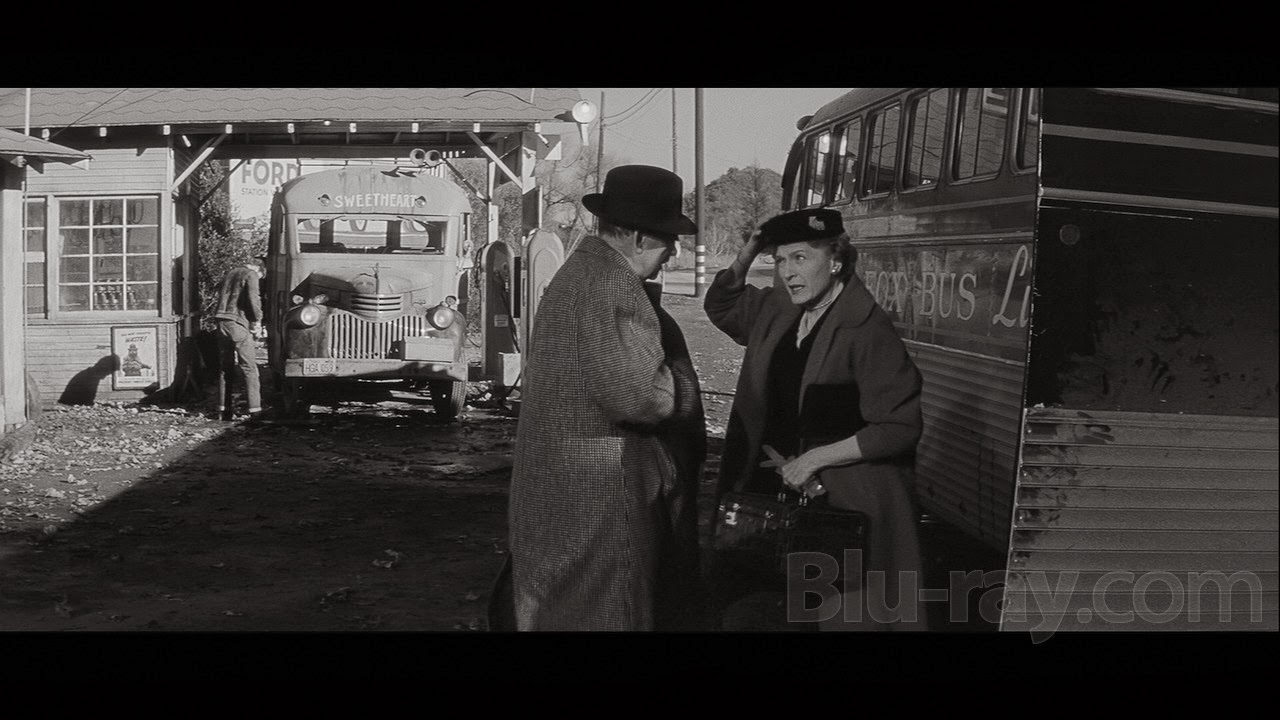
Synopsis: A driver in southern California transports a disparate group of passengers stranded at his Rebel Corners diner to San Juan de la Cruz in his ramshackle bus named, "Sweetheart".

Made a full ten years after Steinbeck's novel was published, with various talent like director, Henry Hathaway, and actors such as Anthony Quinn and Marlon Brando interested in it along the way, the film wound up being directed by relatively unknown, and reportedly prickly European director, Victor Vicas. Rick Jason, the actor ultimately chosen to play the lead character of the bus driver, Johnny Chicoy, was also unknown at the time. Though he would later gain fame co-starring with Vic Morrow in the popular TV show, Combat!, Jason wound up getting under-billed to his fellow co-stars who included a very young Joan Collins, B-movie bombshell, Jayne Mansfield, and veteran character actor, Dan Dailey. 


Having read the excellent Steinbeck novel and knowing a little of the troubled history of the studio's attempt to bring the adaptation to the screen, I braced myself for a trainwreck but was pleasantly surprised at the quality of the film. The first thing that jumped out at me was the exquisite CinemaScope high definition picture. "Stunning black & white" sounds like either hyperbole or an oxymoron but it is an apt description for the look of The Wayward Bus. Veteran Cinematographer Charles G. Clarke, known for films like Miracle on 34th Street, Tarzan and His Mate and Moontide, shot one of the better looking b & w films of the era and director Vicas used the format well and composed shots that fill every additional inch of the widescreen. If I wanted to demonstrate how good a b & w film of the 50's can look on Blu-ray, The Wayward Bus wouldn't be a bad choice.

Being shot in an eye-pleasing format doesn't make a film, although with this one, I'd almost argue that it does, but what about story and character? Well, like even the best Steinbeck adaptations, this one really got diluted in the translation to the screen. And not just sexually neutered as one would expect with a 50's studio film, but softened up significantly particularly in terms of character. Ed 'Pimples' 'Kit' Carson, played by Dee Pollock is a prime example. In the novel, Steinbeck describes 'Pimples' face as "rivuleted and rotted and eroded" with emotions that match his unfortunate physical features. However, the movie version of 'Pimples' has a complexion I could only have wished for in high school and he's downright gentlemanly and responsible to boot. Now I understand you can't make a 50's audience choke on its popcorn with an Eric Stoltz-level of facial abnormality but to fundamentally change the character from an immature needy, horny, revolting young guy (in other words, a typical teenage boy) to a hero is just lazy script writing by Ivan Moffat who adapted the novel. Similarly, the Pritchard parents, who I find the most darkly comic and interesting in the book, get short shrift in the screenplay. The father, Elliott Pritchard, as described by Steinbeck, "...was a businessman, president of a medium-sized corporation. He was never alone. His business was conducted by groups of men who worked alike, thought alike, and even looked alike." One of the best moments in the novel occurs when he attempts to confront Alice Chicoy about accommodations at the diner and she tells him irritably he's holding up her trip to the bathroom. Uncomfortable when away from like-minded people and not seeing any allies among his fellow passengers, Pritchard is defeated by this simple retort. It's Steinbeck's way of pointing out how ineffectual and worthless the modern day, ultra-conformist businessman is outside of his arena. Unfortunately, the movie version of Pritchard loses this facet and is much less interesting as a result. Mrs. Pritchard, who Steinbeck writes as an early example of the passive-aggressive, master manipulator translates to the screen as a prudish, henpecking shrew - a far cry from the multidimensional, meek but domineering character in the book.


Nevertheless, there are characters that make the transition somewhat intact. The incognito stripper, Camille Oakes, as played by Jayne Mansfield, may be the most faithful to the book. She's a very intelligent, savvy character who is well aware of her effect on men and knows how to manage them. Unfortunately, the male characters around her don't have near the strong reaction to her as is portrayed so well in the novel, and the plot complication with Dan Dailey's novelty salesman character seems more than a little shoehorned just to create dramatic tension. The same goes for the reuniting of the Chicoys towards the end of the film - Alice Chicoy basically disappears from the latter half of the novel but is part of the climatic scene near the end of the film.  As for the central character of the bus driver, Chicoy, whose first name was changed from Juan to Johnny for the film (sigh), he is an adequate, if somewhat underwritten, approximation of his literary counterpart.


The most surprising aspect of the film for me was the addition of a danger element in the form of three cleverly staged and edited set pieces employing miniatures. Steinbeck purists may balk as there was no hint of physical danger anywhere in the novel, but I really enjoyed these brief but effective sequences. Oddly, they don't seem out of place at all, and work well to both provide a break in the melodrama and move the plot forward. The models themselves won't fool anyone, but they are so well integrated into the other onscreen events that I felt genuine concern for the characters' safety. Another component that was integral to both book and film is the heavy rain storm the bus has to travel through. The filmmakers did a very nice job establishing the downpour giving the picture a moody, oppressive tone at times.


Despite not getting the sought after A-list cast, I thought the principal actors did a better than average job given the script deviations from the novel. Rick Jason is decent playing a likable, somewhat put-upon everyman which is basically the thrust of Steinbeck's character. Jayne Mansfield, who is so much better in dramatic roles like this than the stereotypical, giggly bombshell comedy stuff she's known for, is surprisingly good with a character she could probably identify with greatly. She has one awkward scene that's much more the fault of a script contrivance than her acting, but otherwise, she delivers on the role. Dolores Michaels does a very good, understated job playing the Pritchard's daughter, Mildred, a character who in lesser hands could have easily gone off the rails into melodramatic or vamp territory but Michaels keeps it subtle. Joan Collins on the other hand... Well, I'll give her points for taking on as unglamorous a role as she's probably ever played and I heard the English accent only slip out on a couple of occasions. However, she must have been misinformed by someone and believed she was doing Tennessee Williams instead of John Steinbeck because scenery done got chewed. I like over-the-top Joan as much as anyone but I wish Vicas could have told her to take it down a notch.

Despite it's shortcomings, which admittedly come in comparison to one of my favorite Steinbeck novels, I still like Vicas' The Wayward Bus a lot. The rain-soaked atmosphere, the broken down bus, the old diner, the squabbling passengers, and yes, even the dangers of mudslides and rickety bridges prove a decent diversion. Plus, Joan Collins looks good in the tub.
Scores:
movie - 6.75
novel - 8.25


Tuesday, February 25, 2014

Reina de las Rumberas


Smack dab in the middle of the Golden age of Mexican Cinema resided the Rumberas film genre. Rumberas films were tropical flavored musical dramas or comedies primarily set in Latin cabarets. These nightclub locations provided an excellent excuse to showcase the singing, dancing and acting of the "Rumberas", the triple-threat talented female stars of the pictures. One of the most successful of the Rumberas was Ninón Sevilla, a Cuban-born beauty whose paradoxical quality of sensual innocence fit right into the good-girl-gone-bad-but-gets-redemption-in-the-end theme that is omnipresent in the genre.  Her onscreen presence is magnetic but never more so than when she's dancing up a storm in one of her oft self-choreogaphed set pieces adorned in some outrageous outfit. I recently watched three of her better known films, YambaóVíctimas del pecado, and Aventurera and quickly fell in love.


My first experience with Sevilla came inside a Psychotronica DVD box set with a film titled Yambaó (aka Cry of the Bewitched) from 1957. Atypical for a Rumberas film, it's set on a mid-19th century Havana cane plantation instead of a modern urban cabaret, and whereas most of the genre was shot in black and white, Yambaó is drenched in glorious Eastmancolor. Sevilla plays the titular, Yambaó, a young woman acting as a vengeance proxy for her grandmother who was run off a cliff and left for dead by the local plantation's slaves believing her to be a witch. Yambaó's grandmother, who makes no bones about actually being a witch, wants her granddaughter to kill everyone involved but the matter is complicated by Yambaó's love for the married plantation owner. Sevilla, wearing dark make-up and sporting dark hair, plays a racially mixed character which is a little daring for the time but makes sense as most of the slaves on the plantation are of African origin. It also adds an element of taboo due to her forbidden love of the master. To further complicate things, the master's wife is pregnant with their first child and there's a deadly plague going around. Of course, as in all Rumbera films, none of this melodrama will deter the singing and dancing.


Outside of Sevilla's amazing physical charisma, there were two big things that surprised me about the film. The first was how smoothly the musical numbers were woven into the story feeling quite organic despite the absence of a club environment to support them. Unlike a lot of musicals where everything stops for the big number, Yambaó's pieces flow along with the story and are character defining. As an added bonus, they are also very brief in duration and get right to the point. The first number, where Yambaó is introduced, is a prime example. She shows up centerpiece-d between trees, naughtily freak dances all the young men, strikes a pose at the plantation owner and then spits at his foreman. Mission accomplished in record time - we immediately get a since of who this character is in the quick, efficient, stylish dance performed by Sevilla.


The second thing that surprised me about the film was its transgressive and steamy qualities. A bi-racial girl stealing a married man from his pregnant wife? And swimming naked in front of him? And dancing before pagan idols while sacrificing animals? Keep in mind this is a film made in the 50's for a sexually conservative, Catholic-based culture. I got cranked up watching it today, I can't imagine the effect it had on Latin males in the 50's. It's no wonder the Mexican league of decency put the kibosh on Rumberas films effectively ending their production by the early 60's. 


At the center of all this steaminess is Sevilla herself whose Santaria-influenced dances, stunning screen presence and melodramatic acting style all bolster the material to well above the average. She's so strong a presence in fact that the other actors tend to get blown off the screen by her and the film tends to stall when she's not in a scene. Happily, that rarely happens and the movie is highlighted by her appearances in all but one of the brief but effective musical interludes. Though the story is relatively simple and straightforward, it's the stylish execution of the musical numbers and Sevilla's participation in them that make the movie worth watching.

***

After being completely taken in by her charms in Yambaó, I watched another Rumberas film from 1951 starring Ninón Sevilla called Víctimas del pecado or Victims of Sin. Directed by Mexican cinematic icon Emilio Fernández, the film tells the story of a club dancer who rescues a baby whose mother's pimp has just made her literally throw away in the trash. Much more unintentionally campy than Yambaó but just as earnest, Víctimas del pecado features Sevilla as a fallen young women trying to do the right thing but constantly encountering societal obstacles. From a thematic perspective, the film is quite strong dealing with such issues as the inequality of women, the powerlessness of children and the difficulties of the economically disenfranchised. Fernández occasionally even mixes in some strong imagery to drive his points home.


The problem, if there is one, is that the serious overtones of the film are offset by the joyous musical numbers and heavy-handed melodrama which tend to give the film a campy quality that probably was not intended. That certainly doesn't mean it can't be enjoyed on that level, quite the contrary. To give an example of how deliciously over-the-top the melodrama is, early in the film, just after Sevilla's character arrives to pull the baby out of the trash, a garbage truck shows up and empties the can it was just in. It's unintentionally hilarious touches such as this that make the film fun. The introduction of the pimp character, played with gusto by Rodolfo Acosta, is enjoyably campy too as he downright preens after getting out of a barber's chair. His mega-evil character is love-to-hate despicable, and in Acosta, there is an actor who can actually share the screen with Sevilla without getting vaporized by her. My only wish was for more scenes between them.


The musical numbers in the film are Busby Berkeley-esque in style and quite enjoyable, but unlike Yambaó, they don't really fit in with the serious themes or story. Much like many Bollywood films, the upbeat, overproduced dance sequences feel a bit shoehorned. But knowing Sevilla's character is employed as a dancer at the cabarets in the film, it does make story, if not tonal, sense to see her at her workplace.


Given the limitations of era, schedule and budget, Fernández did an admirable, quite professional job directing the film. I particularly like some of his establishing shots which really give a sense of location and feel very noir-inspired. As much as I enjoyed the campy melodrama, I wish there could have been many more of these location shots as Fernández definitely had an eye for them and they give the story some much needed gravitas.


***

Elena (Ninón Sevilla) comes home from dance class to find her mother in the throws of passion with a family friend. Afterward, the mother leaves a note that she's running away with the friend and her distraught husband shoots himself and is discovered by daughter Elena. Elena then leaves town to look for work in the city where an acquaintance offers to find her a job, gets her drunk, hands her over to a cabaret owner who rufie's her and forces her into prostitution and also makes her the spotlight dancer at her club. 


Thus encapsulates the first half hour of the 1950, Alberto Gout film, Aventurera, and it only gets better from there. Unlike Víctimas del pecado, Aventurera has no thematic pretensions but is just pure, unadulterated melodrama at its most extreme. There must be at least a half dozen "oh no she di'n't" moments scattered throughout the film that caused me to squeal with amazement and delight. The first involves Elena breaking a bottle over her mother's lover's face and putting the boots to him WWE-style in front of a club full of patrons. She also gets into cat fights, drives getaway cars and seduces younger brothers. Every time I thought the movie was going to settle down and become ordinary, Sevilla's character would go into crazy-bitch mode again and unleash. In the latter half of the story, she becomes even more vengeance-minded, though her machinations become less physical, she's no less subtle in reaching soap operatic levels. Sevilla is paired with Mexican film icon Andrea Palma who plays her nemesis as the cabaret owner/white slaver Rosaura. Palma is perfectly cast and her character appears almost up to the task of taming Elena.


But with all the over-the-top melodrama, don't forget that this is a musical where Sevilla sings and dances in fruit costumes. What's surprising is just how good the musical numbers are, particularly the wistful title tune, and I dare anyone not to enjoy the Chiquita banana song or not relish Sevilla's coconut headdress in the Samba number. The opening harem number also impresses with its lavish set up.


Aventurera takes itself seriously and is very earnest in its storytelling but nevertheless moves along at a brisk pace. It's camp appeal is undeniable but Gout and Canadian cinematographer, Alex Phillips, shot a very good-looking film that may entertain for all the wrong reasons but is nevertheless a high quality production. Sevilla once again has the skills to put on a one-woman show but is ably backed in this effort by a strong supporting cast, well-crafted music and professional direction. The fun, overly melodramatic script is just the cherry on top of the coconut.

Final scores:
Yambaó 6.75/10
Víctimas del pecado  7.25/10
Aventurera 8.25/10


Wednesday, January 29, 2014

Eye Spy


It seems like all the best thrillers contain an unhealthy amount of voyeurism. Rear Window, Psycho and Peeping Tom are three prime examples of the visual fetish. But despite the practice's creepy connotations, it's not necessarily performed by an evil antagonist character in every story. Yes, sometimes the voyeur is indeed a villainous stalker watching and waiting for the opportunity to pounce on an unaware victim. But just as often, he's the hero who espies something nefarious while involved in some surreptitious peeping and intercedes to put things right. In Mark Peploe's 1991 low-key thriller, Afraid of the Dark, you're not quite sure what to make of the enigmatic little boy who always seems to be in the right place at the right time to witness something awful. And that's what makes the film worth watching.

Synopsis: The blind community of a large English village is terrorized by a razor-wielding slasher while a young boy looks on.

The story is told from the perspective of the unassuming, quiet, Lucas (Ben Keyworth), an only child who lives with his parents, Frank (James Fox) and Miriam (Fanny Ardant). Frank is a local policeman and Miriam is a visually impaired homemaker, so when a lunatic begins slashing the faces of blind women in town, the family is doubly invested in the crimes. That the slasher does not kill his victims but only disfigures their faces somehow makes the incidents even more disturbing and has everyone in the community including Miriam understandably freaked out. After Lucas overhears a conversation between his parents concerning the attacks, it's not long before he witnesses one through his telescope.


What differentiates Lucas from other heroic voyeur characters in similar mysteries is that he doesn't appear to be "on the case". Rather he just keeps stumbling into the vicinity of where the victims happen to be when the attacks take place. This seems much too coincidental but it is more than satisfactorily accounted for in the brilliant second half of the film. Lucas likewise runs into creepy suspects like the window washer (Struan Rodger) who works at the clinic for the blind, and the locksmith (David Thewlis) who lasciviously eyes Miriam's friend, Rose (Clare Holman), while working at her flat. Even Lucas' eventual run-in with the killer appears to be pure happenstance but makes logical sense when the explanation is subsequently inferred. 


Spoiler Alert (Not whodunnit, just what it all means)
The mystery gets solved at exactly the halfway point of the film and it is a tense, effective and satisfying climax. But with the story wrapped up, what happens next? Would Lucas grow up damaged and become a criminal himself? Would he be spurred on and become a cop like his dad? Would he catch pneumonia and die from being out in the rain while spying on the slasher? Actually, none of these things would happen. Maybe someone smarter than me could have been tipped by the child-like storytelling of the first half with its amazing coincidences and heroic conclusion, but I doubt it. With no fanfare or overt explanation, the movie basically reboots at the halfway point. What occurs in the beginning of the second half is an interesting shuffling of the characters and their traits that will leave most viewers momentarily flummoxed. For example, the Fanny Ardant character is still Lucas' mother and she is not blind but very pregnant. Her friend, Rose, is now her stepdaughter and Lucas' sister. Lucas' dad is not a cop but a florist. Several of the supporting characters are similarly scrambled but the most telling detail concerns Lucas himself - he's going blind. Once this information is revealed, the first half comes into focus clearly. And while Lucas was the somewhat morally ambiguous hero of the first half, he may well be the villain of the latter part of the story. Still, it's not cut-and-dried, while Lucas is weird and possibly unhinged, he remains an interesting, somewhat sympathetic enigma who is as opaque as his coke-bottle glasses and as threatening as his knitting needle.


Director and co-writer, Mark Peploe, who received an Oscar for co-writing The Last Emperor created a really nice Hitchcockian piece here that reminded me a lot of Michael Powell's Peeping Tom. The movie is subdued but there are some very effective suspense and horror elements scattered throughout that prevent it from ever becoming dull. There are some style components also like the blowing red curtains framing the window where Lucas witnesses an attack and the mirror reflecting him and his awesome peepers in the opthamologist's office. The cast is deep and consists of some strong English character actors along with the French Ardant and even the smaller supporting roles are played by very recognizable veterans like Paul McGann, Sheila Burrell and Robert Stephens. The story structure with its discombobulating break at the halfway point may be its strongest feature and certainly makes for a unique film.

Score 7.75/10