Tuesday, March 12, 2013

It's All About the Benjamins


"In all your Amours you should prefer old Women to young ones."

-Benjamin Franklin

"Mrs Robinson, you're trying to seduce me."

-Benjamin Braddock


When I was in high school, the slangs "MILF" and "Cougar" had not entered the vernacular. When referring to a good looking, sexy, mom-aged lady, we usually used the title, "Mrs Robinson". I was lucky enough to live across the street from a "Mrs Robinson" all through my formative years. She scandalized the neighborhood and got tongues wagging by having the temerity to ride her bike and do her gardening in short shorts. I had a front row seat to her supposed lasciviousness as my bedroom window faced her garden. It was torture, but the good kind, if you know what I mean. I was painfully shy and had a tough enough time getting to first base with a girl my own age, much less, swinging for the fences with an older woman, but nevertheless, I did wonder...


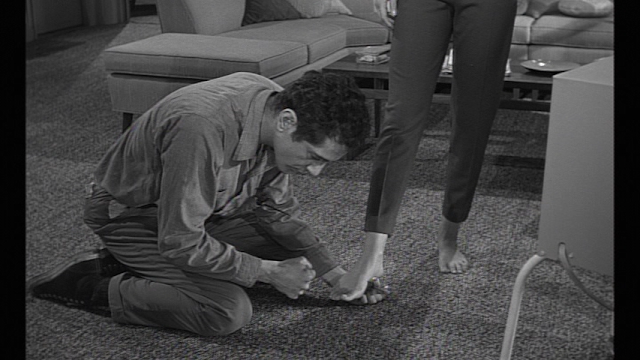
The fascination with my high school neighbor probably goes a long way in explaining my love of the formerly taboo-breaking cinema involving younger man/older woman romances. There were a flurry of these type of films, that came out between 1967 and 1973 including The Graduate, Harold and Maude, Summer of '42, The First Time and 40 Carats. It's not surprising that they are all comedies given the success of The Graduate and the inherent, sexually charged subject matter of the films. Joking about the age difference between the leads makes it a much more palatable affair but, unfortunately, also lessens the drama and outright shock value. What is surprising, is that all the aforementioned movies were beaten to the screen by a somewhat risque, 1961 melodrama called, A Cold Wind in August that features a relationship between a 17-year old maintenance boy and his sophisticated stripper neighbor.


Iris (Lola Albright), is a worldly stripper who keeps her business on the low-down and outside of New York where she resides in her brownstone apartment anonymously. As the story begins, she receives a visit from her loser, ex-husband who begs her to perform at a local club he's booking. Iris' air conditioner is on the fritz so the scene plays out in sweaty desperation with Iris giving her ex a reluctant maybe response while he looks out the window on a youth below who's playing with a broom he's just set alight. The youth turns out to be Vito (Scott Marlowe) the son of the building's maintenance man (Joe De Santis). When Iris calls to get her A/C fixed, Vito's father dispatches him and the fun begins.


The most surprising aspect of the movie is that it's played as a straight-up drama from start to finish, and although it does slip into melodrama near the end, it respects its characters throughout keeping them both believable and sympathetic. Although Iris does initially put the moves on Vito (and boy, does she ever) she's neither predatory nor pathetic in her pursuit. She seems somewhat of a lonely person and weary of the people that populate her life. She genuinely falls for Vito, seemingly in a large degree, because he's not a part of her other life. Vito himself is age appropriately innocent, although he does chase girls occasionally bringing them up to the roof for make-out sessions. What I particularly enjoyed about Marlowe's performance is that he didn't play Vito as a jittery, clumsy dork. Vito is certainly out of his element with the more experienced Iris, but he doesn't fall apart in the face of her considerable sultry, sex appeal or sophistication. One of my pet peeves in these type of stories is that no intelligent, experienced woman would ever go for a hapless geek because he has nothing to bring to the relationship table or bedroom for that matter. Vito has confidence born out of boyish charm, good looks and success, albeit limited, with the opposite sex. This is what makes his character, and thus the relationship, believable. 


Another element that came as a pleasant surprise was the incredible sweetness of the relationship, not only between Vito and Iris, but Vito and his father. I kept waiting for Joe De Santis wise, old father character to pull his son aside and chastise him for being with an older woman, but the character stunned me by not taking the same old hackneyed moralizing path and actually had a genuine talk with his son about not denying emotional involvement and behaving like a grown man. The loving, involved, believable relationship between father and son was incredibly refreshing and something that's rarely seen in modern cinema. Although Marlowe and De Santis only have three or four brief scenes together, they really resonate and are well written and performed.


In addition to the sweetness, there is an overt, undeniable sexiness to the Vito/Iris relationship that, for the most part, is played very matter-of-factly. Certainly, there are notable exceptions, as when Iris is flirting early on and asks Vito to light her a cigarette. When he attempts to hand it to her, she refuses to take it in her hand and motions for him to put it directly into her mouth (God, I miss smoking). For the most part though, their sexual intimacy is portrayed very casually, playfully and balanced making it that much more authentic and erotic. It doesn't hurt that Albright and Marlowe are two of the better looking character actors of their time and seem to have genuine chemistry not too mention a lot of acting experience between them.


The film was Alexander Singer's first directing turn and he did an excellent job especially in framing the shots. Singer would go on to be a journeyman TV series director for the next four decades, most notably directing no less than 22 episodes of the later Star Trek incarnations, but his cinematic skills are apparent even in this initial effort. The crisp, black and white photography was shot by Floyd Crosby who did a lot of great genre stuff, not the least of which was the Corman/Poe films of the early sixties as well as classics like The Old Man and the Sea and High Noon. The music, by Gerald Fried, is one of the few flaws of the film as it is overblown, big band stuff that is mostly at odds with the quiet intimacy of the story. 
In summary, the film is a surprisingly serious and somewhat erotic romance that doesn't take it's characters or story lightly. It's intelligent, mature and sexy especially considering the year it was made.

Score: 7.25/10


Tuesday, February 19, 2013

Britannic


Beginning in 1968 with the first Airport film, disaster movies ruled mainstream cinema well into the mid-seventies. For some reason, audiences of the time seemed to like watching stuff get "blowed-up real good". The typical disaster flick featured big casts of A-list (and former A-list) stars like Paul Newman, Charlton Heston, Burt Lancaster, William Holden along with high production values and special effects. Most of these films were overly earnest, highly melodramatic affairs that became ripe for parody late in the genre's cycle by films like Drive In and Airplane. In 1974, at the zenith of the disaster film's popularity, a year in which both The Towering Inferno and Earthquake were released, a big budget movie with an all-star cast about an ocean liner in peril was also debuted.


The movie's poster screams disaster flick and it was certainly marketed that way, but unlike The Poseidon Adventure or the numerous versions of Titanic, Richard Lester's follow up to The Three Musketeers is anything but a melodrama driven, special effects orgy of destruction. Quite the opposite, Juggernaut is an almost intimate, intense thriller, laced with an undercurrent of subtle but brilliant humor.

Synopsis: When an extortionist known only as "Juggernaut" threatens to set off seven bombs placed on an ocean liner unless he's paid £500,000, a group of military explosive experts are parachuted in to disarm the devices.


The plot basically takes a three-pronged approach following three different groups involved in the story. The first group is the explosive ordinance disposal team led by Richard Harris as Lt Commander Fallon. The second follows the Scotland Yard investigation led by Anthony Hopkins as Superintendent McLeod. The third group consists of the ship's passengers and crew featuring Omar Sharif as the ship's Captain, Roy Kinnear as the Social Director, Clifton James as a passenger along with various others. Ian Holm also has a small but important role as the sympathetic Managing Director of the cruise line. The movie alternates between the different groups keeping the story moving at a sure pace and preventing boredom from setting in by not sticking with any given character for too long. While Fallon and his team go about the delicate work of disarming the intricately crafted bombs on board the ship, Scotland Yard begins looking for suspects on land who have the required knowhow to construct such devices. Meanwhile the crew attempts to deal with the passengers who suspect something's amiss.


The filmmakers did a very good job at creating tension but what really kicks the movie up a notch is the humor that's woven in throughout. Most of it comes, not from the leads, but from the supporting players. Roy Kinnear's character is the most overt example as he plays a hapless social director who now must keep the entertainment going on a possibly doomed ship filled with a lot of worried passengers. His character appears to be inept even under ideal conditions. More interesting and subtle is  Roshan Seth's Indian steward Azad who plays up his foreign-ness so as not to have to interact with the passengers as much. One moment, he'll be fumbling for words and speaking with a heavy accent while dealing with passengers, seconds later he's talking in a passable English accent about football with fellow crew mates. There's also a running joke with the crew who pretend not to notice that Shirley Knight's married character is clearly the Captain's mistress. When the 3rd mate reports to the Captain's cabin and observes what is obviously a 'morning after' situation, he turns down a cup of coffee from Knight, by replying clumsily, "Thank you, but I've already had some - coffee". As in Lester's, The Three Musketeers, this type of throwaway humor appears again and again, but is so matter-of-fact and underplayed, it's easily missed on the initial viewings but nevertheless enriches the film greatly especially on re-watch.


The casting is brilliant right down to the minor roles. In particular, David Hemmings as Fallon's sidekick, Charlie Braddock, was strategically smart as it means Harris' A-list status will not save him from being taken out of the film at any time. The way in which the bomb defusing works is Harris' character attempts to disarm the first device with Hemmings following his moves with the second bomb and so on. Casting a big name like Hemmings as the second in charge really removes the 'they won't kill the star' factor and adds to the tension. I also liked Ian Holm's tortured manager character as he was written against type and played beautifully by Holm who seems genetically incapable of a sub-par performance. There's also a surprisingly non-cartoonish turn put in by Clifton James who plays a smart, perceptive and decent guy for a change, although he still chomps his signature cigar. Overall though, it's the magnificent bastard, Richard Harris, who anchors the movie as the wry, self-confident but fatalistic Fallon. Few actors can hold the screen like Harris and this is a perfect, intimate type of role where most of the time it's just Harris and the camera. He does start chewing scenery with Sharif later on in the film but I think it was in response to a rare fallow point in the script where they just needed some drama planted and Harris took it upon himself to be the farmer.


The negative aspects of the film are fairly innocuous but quite apparent script shortcomings. For example, the coincidence of the Scotland Yard inspector's wife and kids being passengers on the ship is a bit much to believe and really does nothing to add to the tension. A brief explanation on how the explosives were brought on board would have plugged an obvious plot hole. And Omar Sharif's Captain doesn't seem to have a heck of a lot to do besides getting yelled at by Harris and looked at forlornly by Knight. On the other hand the film did a few crucial things right. The parachute scene was critical in showing why it would be to dangerous to just off-load the passengers to avoid getting them blown up. The chalkboard diagram of the bomb was a nice visual touch to help the audience understand what was going on. And lastly, much of the film actually looked shot on board a ship as opposed to a set with a fake sea backdrop which really helped sell the ocean-bound feel.

In summary, the attention to detail, the subtle humor and the stellar cast make this one of the great thrillers of the 70's. The fact that it's not a disaster movie is actually a good thing.

Score 8/10


Friday, January 25, 2013

Giallo IQ Test


Find out if you are a brilliant, stealthy, killer or a brain-dead, hapless dupe by taking my giallo IQ test. The grade scale is at the end of the quiz with the answers below that in fine print. Score 1 point for each correctly answered question. Use of alternate titles is acceptable.

1. Name 5 giallo titles that contain the color black.

2. In what giallo was the setting partially lunar?

3. Name 5 creatures that appear in giallo titles other than Argento's animals (bird, cat and fly).

4. Name 3 gialli with Mimsy Farmer.

5. Name 3 "bloodstained" objects in giallo titles.

6. Which of the following countries has not been the setting for a giallo - Australia, Iceland or Haiti?

7. Name 3 gialli with Suzy Kendall.

8. In what giallo was a phallus used as the murder weapon?

9. What giallo was set in New Orleans?

10. What three giallo films were based on Edgar Wallace stories?

11. Name 3 gialli with Florinda Bolkan.

12. In what giallo was a portable power saw used as the murder weapon?

13. Name 5 gialli with numbers in the title. 

14. What giallo featured "God" as a character?

15. Name 3 fashion accessories that appear in giallo titles.

16. Name three Lenzi/Baker collaborations.

17. What giallo was set in San Francisco?

18. In which giallo did Nicoletta Elmi not appear - Deep Red, Footprints on the Moon, Who Saw Her Die?, Short Night of Glass Dolls?

19. In which giallo were crows employed to find the killer?

20. What giallo was set in Ireland?


18-20 points - Black Gloved Assassin   Way too much knowledge, you must be the culprit!

15-17 points - Accessory to the Crime  Knowledge implicates you in the conspiracy.
12-14 points - Red Herring                    Appear knowledgable but are actually an innocent.
  9-11 points - Innocent Victim              You obviously don't know enough to be dangerous.
  6-8   points - Super model                     Run for your life stupid!
  5<    points - School Girl in Peril          Nice knowing you, Solange.


Answers:

 1. The Perfume of the Lady in Black, A Black Veil for Lisa, 7 Notes in Black, Vice Wears Black Hose, Black Belly of the Tarantula.
 2. Footprints on the Moon.
 3. Lizard in a Woman's Skin, Iguana with the Tongue of Fire, The Case of the Scorpion's Tail, Don't Torture a Duckling, The  Bloodstained Butterfly and A Dragonfly for Each Corpse
 4. Four Flies on Grey Velvet, The Perfume of the Lady in Black, Autopsy
 5. Shadow, Butterfly, Orchids
 6. Iceland. Australia was the setting for The Pyjama Girl Case and Haiti the setting for Tropic of Cancer.
 7. Spasmo, Torso and Bird with the Crystal Plumage. In the Devil's Garden (1971) is also acceptable although not technically a giallo.
 8. The Sister of Ursula
 9. Dario Argento's Trauma
10. What Have You Done to Solange, Seven Bloodstained Orchids and Double Face (1969)
11. Lizard in a Woman's Skin, Footprints on the Moon, Don't Torture a Duckling
12. My Dear Killer
13. 5 Dolls for an August Moon, Seven Bloodstained Orchids, The Red Queen Kills Seven Times, The Fourth Victim, The Fifth Cord, 2 Masks for Alexa, The Killer Reserved Nine Seats, Four Flies on Grey Velvet, 7 Murders for Scotland Yard, The Two Faces of Fear, Seven Deaths in a Cat's Eye, Seven Notes in Black
14. Four Flies on Grey Velvet - Bud Spencer played the character Godfrey or "God" for short.
15. Vice Wears Black Hose, The Perfume of the Lady in Black, A Black Veil for Lisa
16. Paranoia (1969), So Sweet, So Perverse, A Quiet Place to Kill
17. One on top of the Other (Perversion Story)
18. Short Night of Glass Dolls
19. Opera (1987)
20. Iguana with the Tongue of Fire

Sunday, January 6, 2013

A Serbian (Train) Film


Warning: minor spoilers on the tracks ahead...
Cruising through Netflix Instant Watch a few weeks ago, I came across this horror movie featuring a satan-possessed, runaway, Serbian train. For some reason, I can't resist movies set on trains or about ridiculous satanic cults, so I dove on this one immediately. As expected, it was cheesy and over-the-top horror from the late 80's, but it was also a whole lot of fun and surprisingly well edited and photographed given the premise and small budget. The film was originally titled Beyond the Door III but is a sequel in name only. It is its own complete story unrelated to any of its namesakes that have come before. Whoever retitled the movie actually did it a service, although I would have come up with something more fitting like 'Satan's Serbian Box Cars' or 'The Devil's Virgin Caboose' or maybe just 'Hot Soup for Your Soul'. What the film ultimately amounts to is a slasher in goat's clothing. The satanic cult stuff comes primarily at the beginning and end of the movie, and exists mostly to provide an excuse for the heroine to be chased, the train to do impossible stuff and Bo Svenson to look devilishly suave (and get a paycheck). The middle of the film is pure slasher with people getting whacked in a variety of gory ways, usually involving some supernatural component, a train and a mannequin.


The plot centers around a college girl named Beverly Putnic who, along with six of her classmates, get an opportunity to travel to Belgrade on some kind of anthropological field trip. What's hilarious (intentionally?) is how everyone from her college professor to her mother keep telling Beverly how lucky she is to be going to Serbia. I don't remember Serbia being a vacation hotspot, but Beverly's mother must have at least suspected satan hangs out there as she gives Beverly an ancient religious tome as she's leaving. Beverly herself seems to have no inkling of what's happening despite the humongous, devil horns birthmark that cover her midsection.


This is the first of many none-too-subtle clues that beelzebub may somehow be connected to Beverly. Later, at a dinner, she receives a welcome present in the form of a devil horn charm identical to her birthmark which is called "the sign of the pagan virgin". As far as her character goes, Beverly is pretty taciturn, grumpy and thin-skinned, especially when it comes to being teased about her virginity. Character-wise, this is one of the big flaws of the film in that none of the kids' personalities are developed any more than absolutely necessary. Granted, many of them will become cannon fodder, and the lack of character building does keep the film moving quickly, but at least in Beverly's case, it would have been beneficial to make her more of a sympathetic person. As written, she seems like she's having a bad case of PMS, and the actress who plays her, Mary Kohnert, doesn't have much else with which to work so there's a lot of moody glaring.


Once the kids make it to Belgrade, they are met by their hosting professor, Buford Pusser - I mean, Professor Andromolek, played by a bearded Bo Svenson. He rocks a black overcoat, red scarf and tie better than the dark lord himself and his acting is wonderfully atrocious. It sounds like he made the conscious decision to pause every four words to either illustrate that English is his second language or to be menacing, I can't figure out which. Despite this (or because of it), he's still a hoot to watch and chews the scenery up nicely especially when his character tries to foist drugged, hot soup on Beverly.


This scene occurs after Bo has taken the kids to a rural Serbian village where they are to spend the night. The village looks like something straight out of the Resident Evil 4 video game and has (you guessed it) a devil horns logo near the entrance. The kids are then taken to their hovels, given "hot soup" at which point the villagers start playing a strange game of tick-tac-toe involving goat's blood and two by fours. Bo's sidekick/crone and maker of hot soup, Vesna, does a virginity check on Beverly (don't ask) and then fires spontaneously combust inside the houses of the kids who are inadequately trapped inside. All of them bust out save for one (who really didn't seem to mind burning up, at least, his mannequin didn't) and run from the villagers who are standing around clacking rocks together.


It was about this point, I was starting to wonder where the titular crazy train was. I needn't have worried as the kids run directly to it and attempt to flag it down. Failing to make it stop, they jump on board and are helped by a friendly conductor named, Bosco. Bosco travels with a flute player who is not the least bit suspicious looking so you just know he won't be turning up again in the story - OK, he does, in the oddest way possible.


From this point on, the train switches tracks and heads straight to Slasherville with the crew and kids getting bumped off in rapid succession. The kills were somewhere between Fulci and comic book gory and were more darkly humorous than frightening with obvious mannequins taking the brunt of the punishment twice in the form of decapitation.
Besides the fast pace and kills, there are two more aspects that kick Amok Train up a notch. One is the stowaway thief, Sava, who carries a switchblade, wears a WWI pilot's leather helmet, smokes Man With No Name cigars and refers to herself in the third person. After being nabbed by the kids sneaking around in the mail car, Sava exclaims quite haughtily "Sava is thief, not keeller!". Talk about a potential character, Sava should have been the focus of the film as she is wonderfully overdrawn and exceedingly colorful. After being told the train is a runaway, Sava swings into action and starts constructing a bomb from shotgun shells in an attempt to blow the engine off the rest of the train.


The second aspect that boosts the picture beyond the ordinary is that the runaway train itself which is absolutely unstoppable. Even a pesky lack of railroad tracks can't stop it as the train derails no less than three times but then 'rerails' slipping effortlessly back onto the tracks. Even giving credit to that ol' black magic that satan does so well, it's still a ludicrous notion that a locomotive could un-derail. Ludicrous, and insanely fun.


Ultimately though, the train ride has to end and Professor Bo comes to get Beverly in a black, horse drawn carriage - because that's just how satan's minion rolls, I guess, or maybe Serbia was just out of cars that day. And so that there can be no doubt that Bo is truly in thrall to the dark one (as if his red pocket kerchief wasn't a dead giveaway), he has little eyebrow devil horns to tip the fact. In any event, Bo picks up Beverly and informs her she's to wed "The Master" (shades of Manos, I kept looking for oversized elbows on Bo in addition to his satan brows). 


Surprisingly, Beverly seems OK with her upcoming nuptials and there is a big twist at the end involving the aforementioned flute player which actually fooled me as obvious as it was. It's a final bit of goofiness that puts a cherry on this cheesecake and makes the film transcend other trash of its ilk by playing the joke out in a completely straight-faced manner.
In terms of the filmmaking, the strongest technical element is Claudio Cutry's editing which keeps the movie coherent and moving at a pace a story about a satan-possessed, runaway train should. The acting, while not great, is passable enough for a movie of this kind although Mary Kohnert perpetually looks like someone is stepping on her toe, but as I said, part of the problem is her underwritten character. The director, Jeff Kwitny, who's only credited with three other films (including one called White Cobra Express which sports a very interesting cast indeed) did a decent enough job grabbing all the requisite shots including the cheesy train model and mannequin takes. The cinematographer, Adolfo Bartoli, who has done a great deal of work, primarily with Full Moon Pictures, makes this film look better than it has any right to appear.


I have the distinct feeling the filmmakers were stifling laughter just off camera while making this movie, but I appreciate the fact that they never acknowledged it on screen and play it straight despite its unbelievable goofy premise. It makes a train ride through Serbia actually enjoyable.

Score 6.75/10

Friday, December 7, 2012

The Tyranny of Freedom, the Persistence of Structure


We all yearn for freedom, be it financial, political, emotional or otherwise, we forever strive to be the masters of our own destiny. We are told freedom is the optimal condition for humanity to exist in, but is it? Consider some of those who have come closest to living beyond societal or familial constraints. I'm speaking of the most wealthy and powerful. Initially, their freedom appears a good thing, but at some asymptotic point where they are converging on almost total free will and absolute independence from outside control, they begin being seduced by their own darkest desires and self-destruction soon follows. If "...absolute power corrupts absolutely" what effect does complete freedom from boundaries erected by the culture, institution or family have on the individual?
Not long ago, I watched an excellent documentary on Hulu called Shadow Billionaire. It's subject was Larry Hillblom, the man who co-founded the international transport service, DHL. A wizard in organization, Hillblom was largely responsible for breaking up the monopoly held by the US Postal Service in package delivery. I felt a special kind of kinship with Mr Hillblom as we both attended the same tiny, small town high school and graduated from the same modest, central valley college in California, albeit 17 years apart. So it was with some sadness that I watched his rags to riches story that ultimately culminated in his submission to his darkest desires. This behavior continued to have repercussions long after his demise in the form of several illegitimate offspring who laid claim to his estate. With a degree of financial, political and societal freedom that most of us will never know, Hillblom not only destroyed himself, but the empire he helped to establish by surrendering to his darkest desires and denying the families he created.

***


Ever since seeing Serge and Jane's little girl in the François Truffaut penned story, La petite voleuse (The Little Thief)I've been hooked, and over the years, she's become my favorite actor, bar none. Soft-spoken, with doe eyes and long, gazelle-like limbs, Charlotte Gainsbourg doesn't appear to be a tough, iron-willed, risk taker but she's proved herself exactly that over the past two decades with film roles that range from the most avant garde, like Lemming, Antichrist and The Science of Sleep to classics like Jane Eyre and Les Miserables. Working with varied, artistically adept directors, everyone from long time partner Yvan Attal to Franco Zeffirelli, she's currently pulling the hat trick with her third Lars von Trier movie in the past four years. In addition, she's released three musical albums to critical acclaim and speaks flawless French and English. And if that's not enough, on the personal front, she had her third child in 2011 at age 39 after bouncing back from a cerebral hemorrhage in 2007. Did I mention she was tough?


***

SPOILER ALERT: The following review contains spoilers bigger than this car's for both The Little Girl Who Lives Down the Lane and The Cement Garden.


In Laird Koenig's novel The Little Girl Who Lives Down the Lane, a teenage girl goes to great lengths to maintain her freedom and independence. The evil in the story comes from characters both outside and within her family attempting to control the girl and manipulate her for their own corrupt desires or agendas. The little girl, Rynn, wishes only to be the master of her own fate and is not corrupted by her freedom, but does kill to defend it as the absence of family makes her vulnerable to various adult predators. The Koenig novel is kind of an independence manifesto that could apply to the underaged, women or really any oppressed minority. Along with its film adaptation, The Little Girl Who Lives Down the Lane would make a great companion piece to Ian McEwan's The Cement Garden where the child protagonists find themselves exploring their own independence when they too suddenly become free from adult authority. The two stories are an odd reflection of each other in the striking plot parallels that occur in each. Both have dead mothers in the cellar, dead fathers elsewhere and willful kids left alone to fend for themselves. Theme, setting and character-wise, however, the stories couldn't be further apart. Koenig's novel speaks to the potential abuse the powerless must struggle with, whereas McEwan's novel concerns not only the corrupting aspects of absolute freedom, but the persistence of structure, in this case family, which always seems to reassert itself. 


Ian McEwan's novel was faithfully adapted into a film by writer/director Andrew Birkin in 1994. The Cement Garden is set in an aging cinder block tract house surrounded by abandoned, crumbling structures in a lower middle class section of London. A family of six live in the house including the middle-aged mother and father, eldest, 17-year old daughter, Julie (Charlotte Gainsbourg), 15-year old son Jack (Andrew Robertson), 13-year old Sue (Alice Coulthard) and youngest son Tom (Ned Birkin). Early on, both parents die of natural causes leaving the children on their own. To avoid the possibility of being broken up, they decide not to inform the authorities and encase their mother in cement in a basement locker.


Not long after their mother's death, a subtle entropy ensues and the family structure begins to break down. There's some nice imagery used by Birkin to show this slow disintegration including piles of unwashed dishes in the kitchen, broken masonry around the house and an ever scrungier Jack who ceases bathing. With the absence of authority, the four children begin acting out their heretofore hidden and questionable desires. Baby of the family, Tom, is tired of being a boy, and with the help and encouragement of his sisters, begins dressing as a girl. Jack, who is already a typical, taciturn, self-centered, testosterone-encumbered, onanistic, teenage boy, retreats even further into his self-absorbtion and fantasies. He is also obviously attracted to older sister, Julie, but she has only disdain for him initially. Julie herself begins an inappropriate relationship with a 33-year old, slick, upper class, manager-type, named Derek, who drives a sporty red car.


At a certain point, either family structure begins to reassert itself, or it simply implodes, I haven't really been able to figure out the ending to this day. I do know that Jack's transformation near the end plays a big role as does Julie's power sharing. Nonetheless, I think that both characters' actions can be interpreted as either defending or reestablishing the family structure. In the novel, Jack challenges Julie in a game of housecleaning. This simple act symbolically reverses the entropy and structural breakdown that has taken place reestablishing order in the house. I much prefer this device than the movie's in which Jack runs around naked in a rainstorm. The latter is more cinematic, but the former just makes more practical sense, although I guess both can be seen as a cleansing of sorts. Julie ultimately shuts out her older boyfriend Derek, who wants to be part of the family, in favor of Jack who obviously is family. This action further reestablishes and strengthens the family's structure (symbolically anyway, I wouldn't recommend sleeping with your sibling as a way to improve family relations). This is foreshadowed quite nicely earlier in the film when Jack finds little brother Tom dressed as a girl playing  "house" with one of his mates. Tom explains that sometimes he and his friend are pretending to be Derek and Julie, sometimes they are Jack and Julie. Jack realizes he's not only being cast in the father/husband role for the first time, but is a legitimate rival of Derek's.


Subsequently, Jack begins assuming the role of paternal protector by lying about the contents of the basement locker to Derek, even using one of his father's phrases to close out the conversation. It's at this point that Julie also begins to close ranks as well, siding with Jack and turning against Derek. Tom inadvertently spills the beans to Derek, but by then, the family has already reconstituted itself and Derek and the outside world become irrelevant. The last shot of the film, which is remarkably beautiful, is of Jack and Julie sleeping naked, entangled in each other post-coitus, while the blue strobe of a police car illuminates the bedroom.


In the novel, McEwan uses the phrase "still and fixed" no less than three times in describing the environment, or at least, Jack's impression of it. Andrew Birkin's direction picks up on that description with carefully framed still shots of the house, the characters and the surrounding desolate area. This helps amplify the bleakness described in the novel, and gives the film a strange, decaying beauty. This state of decay is further enhanced by the pale, almost sickly, bleached out green and beige color palette that is ubiquitous throughout the movie.


The original score for the film was Ed Shearmur's first crack at composing and it's quite good chamber music that comes in during bridge scenes and at the end but is used with restraint by Birkin as the dramatic scenes need little more to connect with the viewer.

The acting is outstanding, especially that of Gainsbourg and Robertson who carry most of the scenes and have to do a lot of emotionally raw stuff. Their sibling love/hate relationship feels very authentic with all of its arguments and power plays. One example that demonstrates this sibling rivalry early on in the film occurs when Gainsbourg's Julie basically accuses Jack of being self-centered, Jack replies, "If people really like me, they'll take me as I am" to which Julie, after a beautifully pregnant pause, responds simply and icily, "If". This was Gainsbourg's first English-speaking role and she absolutely knocks it out of the ball park. Her character is intimidating, beautiful and more than a little manipulative and Gainsbourg nails her in a quite subtle fashion. In the novel, McEwan describes her beauty as scary to Jack, and this aspect is brought to the screen in a very understated way by Gainsbourg. Every move her character makes in the film seems confident and un-self conscious. 


I don't know whether it was by design or serendipity that the inexperienced Robertson was cast opposite of Gainsbourg, but he acquits himself well in a role where he has to, among other uncomfortable things, pretend to masturbate while looking at himself in the mirror. He seems genuinely uncomfortable around Gainsbourg, up until the end, which suits the character perfectly. Since Jack is ultimately the central character (he's the narrator in the book), the movie wouldn't have worked without a believable performance from Robertson. The other two kids are also excellent representations of the novel's characters.


I don't think there are any weaknesses to the film, although it is intentionally plodding which may put some people off. It is an extremely faithful representation of the novel with only a few minor changes. I'm very surprised Burkin hasn't directed since this picture, though he continues to write, as he is an exceptionally talented director. It is nice to see his niece, Charlotte, continuing to be rewarded in the form of ever more risky and avant garde roles which arguably began with Julie in The Cement Garden.


Finally, I like the thematic notion that there are naturally occurring, freedom-limiting structural entities like family that can create order out of chaos. Too much freedom, as someone like Larry Hillbom might conclude, is not necessarily a healthy thing. We need certain institutions in place to keep some semblance of order and cleanliness even if, or especially if, it puts limits on our freedom and desires.


Final Score 8.75/10


Sunday, November 18, 2012

A Passage to Agatha


Much like Laxmi Chhaya's infectious dancing to Mohammed Rafi's, Jaan Pehechaan Ho, many Bollywood films tend to be bizarre, silly, surreal, manic and all over the place, stylistically speaking. At the same time, they are loaded with energy, fun, and are endlessly entertaining even when they make no sense whatsoever. The incredibly uneven films may give one tonal whiplash, but it's an enjoyably sustained type of injury. So with neck-brace in hand, I decided to check out one I had been meaning to see for a long time.


While researching my post back in July concerning the five theatrical adaptations of Agatha Christie's novel, And Then There Were None,  I was reminded of the 1965 Bollywood film Gumnaam which was said to bare a striking story resemblance to the classic murder mystery. I did not include it among the five adaptations reviewed at that time because I felt sure it would contain widely disparate elements and be it's own odd conglomeration of genres and tones giving it a uniqueness deserving of its own examination.


It turned out, I was correct. After viewing the film, I realized there was no fair way to compare it to the other adaptations. It wasn't a case of apples and oranges, more like apples and unicycles. The movie did contain plot elements that were direct boosts from the Christie novel in that there is a group of people who are left on an island and sentenced to death for murder by an unknown accuser. There is also a love story between the leads and a key red herring, but the similarities mostly end there. It's not just the half dozen songs that make it a thing of its own, but the wild genre jumping from noir to musical to mystery to horror to comedy to thriller that is typical of many Bollywood films. This ever-changing aspect will either delight or frustrate viewers, but makes it all but impossible to compare to its counterparts as its ultimately a unique product aimed at its own unique market. Personally, I love the sheer audacity of attempting to pack so many dissimilar elements into one film and found myself watching Gumnaam with my jaw on the floor but still smiling all the while.


The film's prologue begins in a very noir-ish manner with a mysterious man on a balcony engineering the hit and run death of a man named Sohanlal on the street below. The mystery man then begins making phone calls to various people in what is obviously a plan to get a hold of the victim's estate. While in the midst of these calls, another mysterious man enters the room and guns the first down. While confounding, this turn effectively plunges the viewer into the story and the opening credits which involve a nighttime drive through the city ending at a nightclub.


We then enter the Princess Club where "Ted Lyons & His Cubs" (Mohammed Rafi) are playing Jaan Pehechaan Ho with Laxmi Chhaya going stark raving bonkers on the dance floor. This is hands down the best song in the feature and endlessly fun. If it appears familiar to western viewers, it's because Terry Zwigoff used it in the opening of Ghost World with Thora Birch's Enid mimicking the moves of Chhaya while the movie played on her TV. It was also recently used by Heineken in an ad to sell their suds. It's difficult and rare for something from Bollywood to make its way into the American culture, but this song and dance number's charm is something that cannot be ignored. The nightclub setting is not only a good excuse for the musical interlude but provides pretext for the subsequent gathering in the form of a vacation giveaway to celebrate the club's "Silver Jubilee." Seven winners of a holiday trip are selected by the club's MC and the audience meets each in turn. Among the group are Asha (Nanda), who is the niece of the original murder victim, Rakesh (Pran), a boozing barrister, and Miss Kitty (Helen), a sexy ingenue who enjoys the company of those who drink more than drinking herself as she later explains.


The story then cuts to the seven winners on board a DC-8 winging to their holiday destination. Complications ensue, however, when the aircraft apparently develops engine trouble and has to set down on a remote island for repairs. The group, along with the co-pilot Anand (Manoj Kumar), then go for a walk, at which point, the plane takes off stranding them all. As they search the island they begin hearing the ethereal voice of Lata Mangeshkar singing the spooky song Gumnaam Hai Koi. It may not be the best song in the film, but it does provide a spooky atmosphere that reappears throughout the story.


The group eventually discovers an estate complete with a goofy, but accommodating, butler played by Mehmood. 
The Christie aspect of the story then kicks in with the group being accused of murder followed by characters being killed off one by one. Romance, comedy and musical numbers also ensue, so much so, that the mystery and murder aspects almost take a back seat to the fun and frivolity. I do not exaggerate when I say that for every murder that takes place, a happy-go-lucky song occurs. But this is s.o.p. in Bollywood filmmaking which takes standard cinematic rules concerning tone and pacing and happily chucks them right out the window. I actually like this kind of loopiness which has an innocent and unique charm all its own. And the remaining songs in Gumnaam are pretty darned good and quite entertaining in their own right. In particular, there is a fantasy sequence song, Hum Kaale Hai To Kya Hua featuring Helen and Mehmood (again sung by Mohammed Rafi), that's easily my second favorite production in the movie. Before this number, Mehmood's over the top comedy was really getting on my last nerve, but I warmed to him considerably subsequent to this cheeky performance.


Helen has some very very fluid dance skills as she effortlessly shows when zipping down a huge stair case in heels. She's involved in three musical numbers, but really shines in this one thanks in part to the elaborate sets, her three costume changes and Mehmood's antics. She also shows off her comic chops in a later number she performs with Nanda that's kind of an ode to drunkeness called Peeke Hum Tum Jo Chale.


I actually preferred Helen's saucy bad girl, Miss Kitty, to Nanda's standard damsel in distress, Asha. In fact, the lead characters (and romantic bait), Anand and Asha, felt pretty generic as did their musical numbers together, although I did admire one which was performed in tsunami-like conditions and had to be a tough go for the two leads to execute without laughter or irritation at the elements.


Besides the rather lackluster lead couple, there were a number a few problems with the film outside of the obvious structural one caused by the merging of murder mystery and musical. The biggest issue was lack of character development amongst some of the secondary characters. For example, I never did understand how Mister Dharamdas (Dhumal) was related to the story, or even who he was, or what he did for a living. He wore a safari hat, carried around poison, and whined a lot. That's about as much as I got from his character. The other characters' presence were ultimately explained or could be intuited, but Dharamdas was an unintentional and frustrating enigma.


More on the nitpicking side, but it was nevertheless a big irritant for me, was Mehmood's Hitler mustache. It was obviously done for comic purposes and is even joked about in those terms later in the film, but it really annoyed me to no end. Charlie Chaplin got away with it because he was outright mocking Hitler, but as a comedy prop, it's a massive distraction and an epic fail. Similarly, Manoj Kumar's red hat did nothing for me, but at least it wasn't worn by a former dictator, it's just a goofy, horrible fashion choice on its own.


Finally, the end of the film went on forever, in part, due to an information dump of epic proportions which drags here-to-fore unmentioned characters into the story by way of the killer's motivation. It's a long-winded, Scooby-Doo explanation and reveal that were just not necessary and slow an already long climatic scene down even further. In fact, the whole Agatha Christie aspect to the film only served to slow it down with unneeded ancillary characters and plot. The movie probably would have been better served if it had been some kind of caper film or haunted house story rather than being an elaborate murder mystery. As a musical, I enjoyed it very much, but as a suspense thriller, I found it somewhat ponderous and hazy.

Score 6.75/10